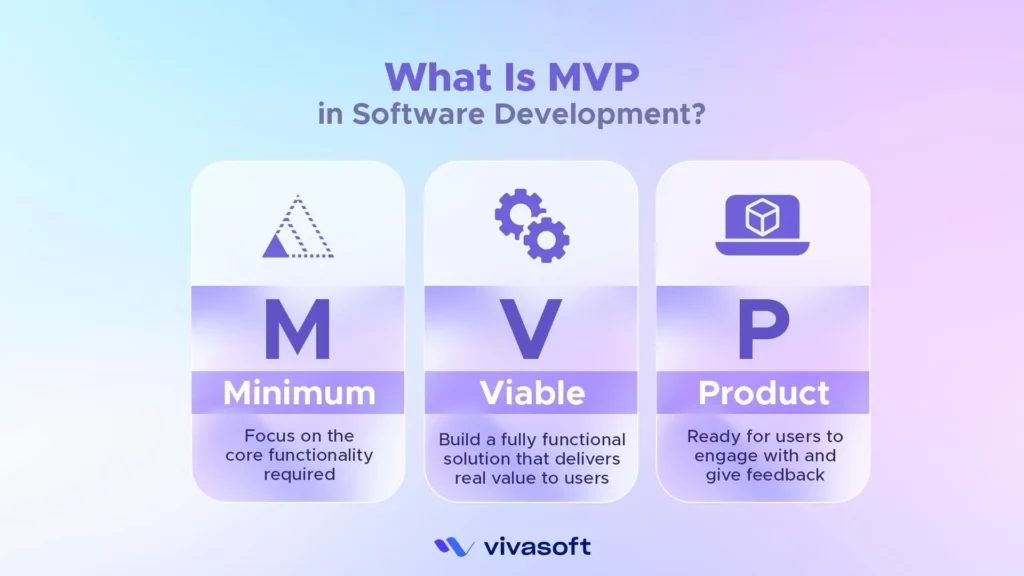
In software development, an MVP is the functional version of the product that is built with just enough features to solve a core problem and collect real user feedback. By validating ideas early, businesses can save a lot from resource management and avoid unnecessary features upfront that no one needs. Approximately 42% of startups fail only due to the lack of a product market fit, and the product features don’t address the user’s problem. This is where an MVP is likely a game-changer, through which a company changes the clear roadmap to design what to deliver to the target audience.
What Does MVP Mean in Software Development?
MVP or Minimum Viable Product is the earliest version of the product that is designed to solve a core problem. It only adds the essential features that help to launch a functional and testable product quickly. The MVP concept was introduced in 2001 by Frank Robinson and popularized by Steve Blank and Eric Ries. Over time, it evolved as part of Lean Startup methodology that reduces the risk of cost and resource wastage. An MVP is not a prototype or a beta version. It is a usable product through which businesses can get real user feedback before full development. As you find in the final product, it doesn’t equip advanced features, integrations, and full-scale UI design. Developers build and release to learn and adjust the development strategies.
MVP vs. PoC vs. Prototype vs. Full Product
Starting from ideation to launch, every product development process goes through a few stages, such as PoC, Prototype, MVP, and Full Product.
| Aspect | Proof of Concept or PoC | Prototype | Minimum Viable Product or MVP | Full Product |
|---|---|---|---|---|
| Purpose | Test technical feasibility | Visualize design and user flow | Validate market demand with core features | Complete product with full features and polish |
| Stage in development | Earliest stage | Early design phase before real development | First usable product released to real users | Final release for the broad market |
| Output | Technical demo or experiment | Interactive mock-up or wireframe | Working product with essential features | Fully functional product ready for market |
| Audience | Internal technical team | Stakeholders, designers, early testers | Early adopters and real customers | All end users, the mainstream market |
| Timeline | Short (days to weeks) | Weeks to months | Months | Ongoing development and scaling |
| Cost | Low to medium | Medium | Higher than PoC/prototype | Highest cost for full development and support |
| Next Step | Move to prototype or MVP | Move to MVP | Build a full product based on feedback | Scale, optimize, and maintain |
| Risk | Technical risk only | Design and usability risk | Market and user acceptance risk | Operational, market, and scaling risk |
Real-World Use Cases
To turn your idea into a highly efficient product, you must choose the right development stage at the right time. Get a clear idea from below:
Proof of Concept (PoC): Start with a PoC to check if your idea or technology is possible. It saves time and resource usage. For example, a healthcare startup might build a PoC to define the integration of wearable tech with hospital systems.
Prototype: Use a Prototype when you want to present UI ideas without full deployment. For example, you are developing a mobile app to show investors. The added clickable prototype made in Figma shows how the navigation would work before coding begins.
Minimum Viable Product (MVP): Build and release an MVP when you want to test if a product solves a real problem. For example, you’re launching a marketplace app for freelancers. For this, you are just building user registration and job posting for validation.
Proof of Concept (PoC): Start with a PoC to check if your idea or technology is possible. It saves time and resource usage. For example, a healthcare startup might build a PoC to define the integration of wearable tech with hospital systems.
Prototype: Use a Prototype when you want to present UI ideas without full deployment. For example, you are developing a mobile app to show investors. The added clickable prototype made in Figma shows how the navigation would work before coding begins.
Minimum Viable Product (MVP): Build and release an MVP when you want to test if a product solves a real problem. For example, you’re launching a marketplace app for freelancers. For this, you are just building user registration and job posting for validation.
Full Product: Move to the Full Product development time when you complete the MVP validation. This is the stage when your user feedback confirms the concept and market need. You can now invest in advanced features or in complete architecture.
What are the Core Characteristics of a Software MVP?
A strong MVP delivers essential features fast and collects real feedback that guides future iterations. Here’s what you need to include:
Essential Features Only
An MVP equips only the minimum set of features that solves your user’s primary pain point. There are no advanced filters, integrations, or personalization layers. Developers utilize efficient methods, such as MoSCoW, through which they can categorize features as must-have ones.
Core Functionality Focus
The MVP must reliably perform the main function without broken implementations. For example, if the MVP is a task manager, the creating task, editing, or status update workflows must work end-to-end. You must avoid half-built features. Broken flows that just confuse users, and you might not get the real feedback.
Simple and Streamlined Architecture
The MVP should be built with a minimal technical stack that speeds up the development process. You should use the lightweight frameworks, reusable modules, and cloud services. Such as AWS Lambda, Azure Functions, which minimize infrastructure setup. A strong MVP should include a clean API design and modular code that can be customized as needed.
Early Usability
Your MVP must be more than a one-prototype. Make sure it is stable enough and the UI flows so that the real users can easily interact with it. The best you can do is use Figma or Sketch for initial UI designs. Incorporate basic form validation and input handling. By using the agile development and testing process, ensure quality assurance so that there will be no confusion while using it.
User-Centered Design
The MVP’s UI and workflows must be perfectly matched with the behavior, preferences, and environment of target early adopters. Develop an MVP with the behavioral data, user journey maps, and pain-point analysis. Also, it should be designed with clear CTAs, minimal clicks, and logical screen flows.
What are the Stages of MVP Development?
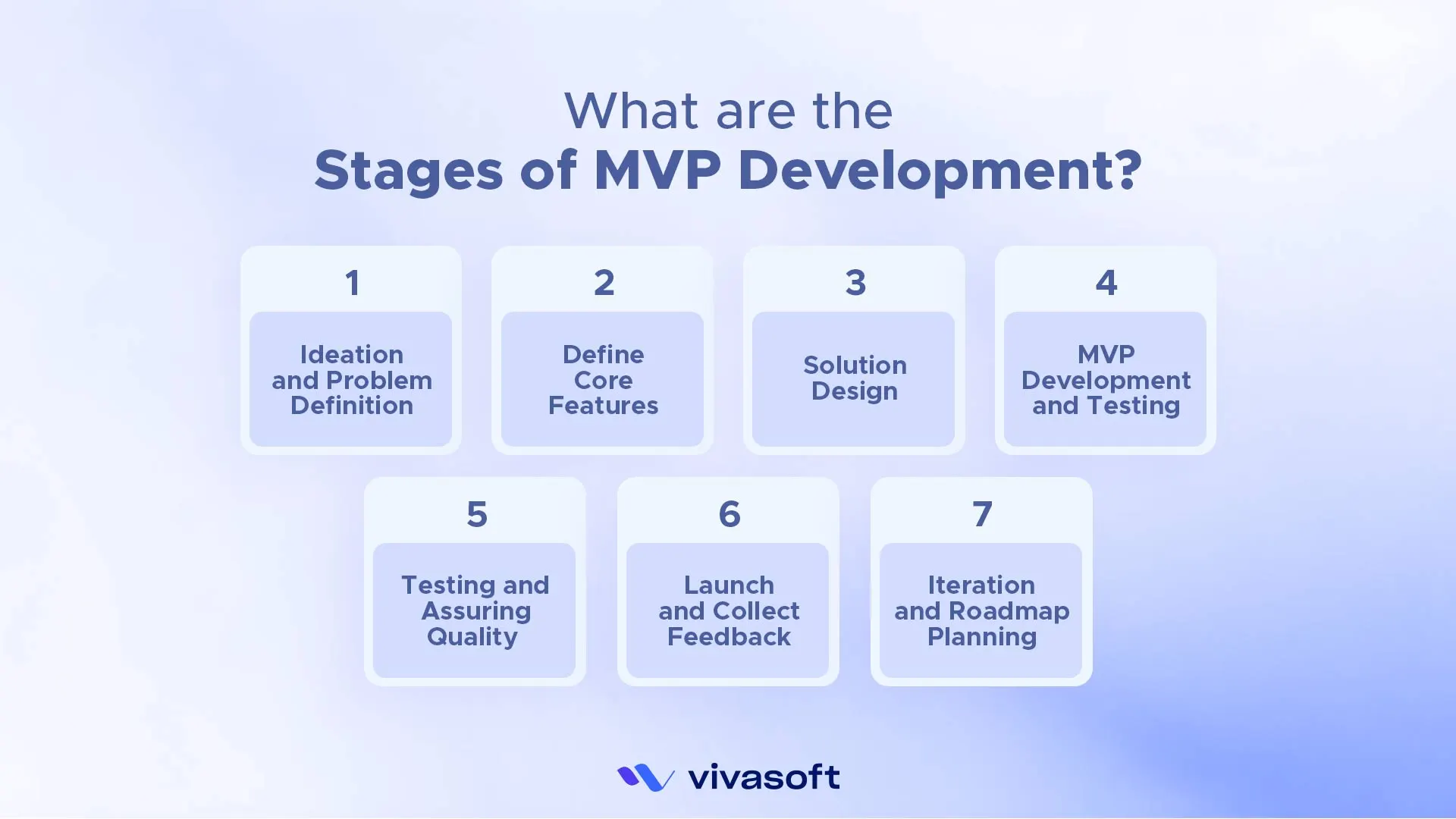
Starting from the ideation to the feedback collection, the MVP development process is done through some specific stages:
Ideation and Problem Definition
First, you have to define the real problems of your target users. Understand their pain points and do competitor audits to find any lacking that you will offer in your product.
Define Core Features
Now, list every possible feature, and find out the essential ones from them. Use MoSCoW or RICE scoring to pick only what’s essential. Focus on 1–2 flows that your users must complete.
Solution Design
When done, this is the time to plan for the complete workflows and wireframes that match user needs. Design the product’s architecture with lightweight frameworks and modular code. The goal is to ensure a smooth experience for the users through simplicity and ease of use.
MVP Development and Testing
The development team then starts building the MVP with the chosen tools and frameworks. It would be good to work on the short sprints for fast feedback. Also, set up CI/CD pipelines for continuous deployment. The final outcome should be fully functional so the user can ensure the best use of it.
Testing and Assuring Quality
Before launch, make sure to thoroughly test core workflows. Even with a minimal feature set, there is still the chance of bugs or performance gaps. You need to identify the flaws and fix them. You can ensure the MVP meets the baseline needs.
Launch and Collect Feedback
Finally, release your MVP to the defined group of early users. After introducing it to the users, observe their interactions with it. And once the MVP is live, collect how the users are getting into it through their feedback. For this, utilize surveys, interviews, or analytics tools.
Iteration and Roadmap Planning
According to the feedback, fix bugs, adjust features, or revise the roadmap. Then start planning for the next development cycles. It is good practice to test each release before adding more features.
What is the Typical Timeline for MVP Development?
The actual timeline to develop an MVP depends on the industry and technical complexity. For the simple MVP with basic CRUD functionality, you may need to wait about 4–6 weeks. Whereas the complex MVPs with user roles, dashboards, or third-party integrations may require anywhere between 10–12 weeks or more. Get a better understanding from the table below:
| Industry Type | Timeline (Typical Range) |
|---|---|
| Standard Web or Mobile App | 3–6 months |
| No-Code or Low-Code MVP | 4–8 weeks |
| Simple SaaS Tools | 2–4 months |
| Simple Consumer App | 1–3 months |
| Complex Healthcare/Fintech | 6–9+ months |
| Enterprise Workflow/Platforms | 6–12 months or more |
Plus, project completion time also varies based on the team size you have and the complexity of features. As you increase the number of features and according to the team member’s experience, the timeline fluctuates. Here’s a sample 8-week MVP timeline:
| Week | Activities |
|---|---|
| Week 1 | Product ideation, user research, and requirement mapping |
| Week 2 | Wireframing, tech stack selection, sprint planning |
| Weeks 3–5 | Core feature development. Such as data flow, main user actions |
| Week 6 | Frontend-backend integration, bug fixing |
| Week 7 | Internal QA, basic UI polish, analytics setup |
| Week 8 | Soft launch, feedback collection, rapid patching |
How Much Does MVP Development Cost?
The cost of MVP development typically ranges between $10,000 – $50,000. However, it varies depending on the project complexity, your team structure, and the technologies you are choosing.
For the simple MVPs with the core features and minimal integrations, you need to consider about $10,000–$30,000. Besides, medium complexity MVPs including multiple features and third-party integrations generally fall between $30,000 and $100,000.
If you are developing high complexity MVPs with advanced backend logic, security needs, and more needed features, the cost can exceed $100,000. For deeper insights, see our guide on how much does it cost to build an MVP.
Can You Calculate the MVP Development Cost by Yourself?
Yes, you can calculate the MVP development cost on your own by following a structured approach.
Begin by clearly identifying all the essential features and functionalities your MVP must include. Then, estimate the approximate development hours required for each element, covering aspects such as design, frontend and backend development, and testing. Once you have these estimates, apply the relevant hourly rates of your internal team, freelancers, or potential agencies you’re considering. Don’t forget to factor in additional expenses like hosting fees, third-party integrations, licenses, and other potential costs. Finally, sum these components to arrive at a comprehensive estimate. To simplify this process, you can use our easy-to-use MVP cost calculator.
How to Build an MVP App for Startups vs. Enterprises?
There are some notable differences in developing MVPs between startups and enterprises. Startups typically focus on cost efficiency and quick validation to get started. Meanwhile, enterprises emphasize strong functionality, integration, and security measures to ensure the MVP is effective for a larger customer base.
MVP for Startups
As a startup, you should start with the core idea with minimal time and cost. For this, just focus on the must-have features that solve a specific problem. Off-the-shelf tools, open-source libraries, or no-code platforms help keep the team on budget.
For instance, a startup launching a marketplace app should focus initially on basic listing and messaging features, delaying complex payment systems until the concept is validated. This lean approach reflects the fundamentals of mvp development for startups.
MVP for Enterprises
Enterprises need MVPs that are integrated with existing systems and meet compliance from the very first. The MVP should be designed in ways that support thousands of users.
For example, a financial institution is planning an internal workflow automation tool. They must go through authentication, encrypted data storage, and APIs that connect core banking systems. In this case, you might need to consider a longer project completion time and a higher budget.
What Are the Key Roles and Skills Needed for MVP Development?
To build a successful MVP, you need a successful cross-functional team with clearly defined roles and relevant technical skills. Following are the key roles in MVP development and their contributions to your project:
- Product Manager (PM): Defines your project vision, plans for needed features, and plays a big role in managing the team aligned with business goals. They ensure to meet deadlines with ultimate team coordination.
- Frontend Developers: Build the user interface and ensure it is working efficiently across devices. Typically, they utilize the needed frameworks and develop interactive apps.
- Back-end Developer: They manage the server-side logic, APIs, and databases. Back-end developers are typically skilled in specialized technologies. They handle data processing and optimize the overall performance as needed.
- UI/UX Designer: Design user-friendly interfaces for your project. For that, they conduct user research, do prototyping, and test the usage.
- Quality Assurance or QA Specialist: Your MVP team should include a skilled QA expert who tests the product for bugs and performance. They conduct automated and manual testing to ensure the MVP is reliable enough.
In-house vs. Outsourced MVP Development
While developing an MVP, you must choose between in-house and outsourced development based on budget and project tiers. With an in-house team, you can ensure better communication and faster iterations. But you may need to consider a longer time for the overall processing. Starting from recruitment, onboarding, to training, it can cause delays and overhead.
On the other hand, outsourcing MVP development from an offshore team offers cost-effective project deployment with access to global talent in specialized aspects, such as UI/UX, mobile development, or DevOps. You get the skilled team on board quickly without the overhead of hiring or managing a full team.
What Are the Common Mistakes to Avoid in MVP Development?
Most MVPs fail due to the lack of proper project planning, team collaboration, or the wrong choice of the technical stack. Here are the common mistakes that cause delays or overheads in MVP development:
- Overbuilding the MVP: Most want to include too many features before launch. It just wastes time and resources. Instead, stick to essential functions that can resolve the core user problem. Utilize flags so you can skip unvalidated features in production.
- Ignoring User Feedback: There is a chance of missing real needs if you rely only on assumptions after launch. You must collect and analyze feedback from your early users. Use tools like Hotjar, Mixpanel, or in-app surveys to investigate the feedback.
- Skipping Testing or Iterations: One of the most common mistakes that most businesses make is releasing an MVP without thorough QA. That way, there is a risk of bugs, crashes, and poor user experience. The best you utilize the methodologies with automated testing frameworks to identify issues earlier.
Some Examples of Successful MVPs
There are numerous case studies that highlight the success of enterprise-level MVPs. These examples show how companies tested their ideas with minimal resources to see if there was real demand before scaling up to fully-featured products.
Dropbox
Dropbox first came with a simple explainer video and tested how file sharing would work across devices. The samples validated the demand and thousands signed up based on the concept alone. The company could analyze the market condition before building a full product upfront.
Airbnb
Airbnb started by renting out air mattresses in the founders’ own apartment during a conference. Their MVP was a basic website that offered a single listing, targeting conference attendees only. That way, the company got a quick confirmation about user interest.
Uber
Uber’s MVP was an iPhone app that connected users with drivers to book rides with credit card payment. It was launched only in San Francisco with just a few cars and a basic app, “UberCab.” In the beginning, it only connected users to black cars and limousines. Once validated, they expanded features based on feedback.
IBM Watson Health
IBM built a minimal version of Watson for oncology diagnostics. Through this, it offered Q&A responses based on peer-reviewed medical journals. At the initial stage, it started the journey with a limited dataset and hospital partners. Based on the feedback, it expanded with broader features.
FAQs on MVP in Software Development
What is MVP in Agile?
In Agile, an MVP is the smallest functional version of a product that offers core value to users. It has just enough features to test the idea, collect early customer feedback, and validate the concept quickly.
Is an MVP only for startups?
An MVP is not only for startups. Companies of all sizes, including enterprises, use MVPs to test ideas quickly. It helps reduce a huge risk before full development.
What comes after an MVP?
After an MVP, businesses typically enter the iteration phase. In this stage, they collect user feedback, fix issues, and add validated features. This way, the product gradually expands into a full-featured solution.