Offshore mobile app development delivers precise advantages of faster launches, richer features, and smarter budgets. It is the most popular outsourcing model for developing a mobile app where you are building your app with a “global team” instead of only hiring locally.
By partnering with skilled talent from worldwide, companies speed up time-to-market and integrate advanced technologies without overspending. This approach allows businesses to build standout iOS and Android apps. From startups demanding quick MVPs to enterprises managing complex digital ecosystems, offshore mobile app development has become the preferred strategy.
Key Takeaways
- Offshore mobile app development offers notable cost savings, ideal for startups and SMEs to manage budgets
- It offers access to specialized expertise globally, including niche skills. Such as AI, blockchain, or any growing framework that may be unavailable locally.
- The model offers business scaling, where they can easily adjust team size as project demands evolve.
- Bangladesh stands out in South Asia as a rising hub of skilled developers providing quality solutions at competitive costs.
- Agile, Scrum, and DevOps approaches ensure offshore teams deliver flexible and high-quality apps on time.
- Continuous collaboration and post-launch support from offshore teams help the app evolve effectively based on user feedback and market changes.
Understanding Offshore Mobile App Development
Offshore mobile app development refers to hiring a skilled team from another country to build your app remotely. This model differs from general outsourcing, where businesses usually work with nearby vendors or local teams within the same region. It gives you the flexibility to access diverse talent partners with deeper expertise, even with lower labor costs. Small startups to all enterprises are already choosing this outsourcing model, grabbing profit, and the market value is projected to be worth $151.9 billion in 2025.
What’s the Difference Between Onshore, Nearshore, and Offshore?
Onshore keeps everything local, and you hire and manage the entire team within your country’s borders. Nearshore shifts work with the neighboring countries that share a similar time zone with you. However, the offshore model places your development team in distant regions with a latent advantage.
Let’s make this clearer with this quick comparison table:
| Factor | Onshore | Nearshore | Offshore |
|---|---|---|---|
| Geographic Location | Same country | Neighboring or nearby countries | Distant countries, often across continents |
| Cost | Highest due to local wages & taxes | Moderate. Even lower than onshore, higher than offshore | Lowest due to significant labor cost differences |
| Time Zone Alignment | Full alignment | Partial overlap (2–6 hours difference) | Limited overlap (6–12+ hours difference) |
| Communication | Seamless, cultural & linguistic match | Easier than offshore, but some differences | Might have challenges, like cultural barriers, language, and time zone differences |
| Talent Pool | Limited to domestic availability | Larger than onshore but smaller than offshore | Widest pool of global talent |
| Engagement Speed | Fast onboarding, minimal delays | Moderate setup, manageable transition | Slower onboarding, longer transition |
| Best for | High-security projects, regulated industries, and close collaboration | Cost balance + cultural closeness, agile collaboration | Long-term scaling, cost optimization, and diverse expertise |
Choose Onshore Development If:
- Your project requires real-time collaboration without time zone delays and challenges.
- Data must stay within your country’s borders for compliance reasons.
- Your team needs frequent face-to-face meetings and in-person workshops.
Choose Nearshore Development if:
- You want faster hiring than local markets offer, but easier management than offshore.
- You want 4-6 hours of overlapping work time for daily standups.
- Your project requires quick responses with less time lag.
Choose Offshore Development If:
- You want maximum cost savings with access to a larger global talent and their professional strategies.
- You need niche skills like AI, blockchain, or AR that often local markets lack.
- You want dedicated companies working exclusively on your app long-term.
- You want to take advantage of round-the-clock development cycles.
Advantages of Hiring Onshore Developers
An onshore development team offers the advantage of instant communication and collaboration, delivering the project efficiently. You get access to them without time zone delays or cultural gaps.
Some more key advantages include:
- Zero time zone challenges: Your team works your exact hours. You can schedule meetings and collaborate at your convenience during office hours.
- Hands-on management: You can directly oversee every development stage. For instance, you can quickly identify issues and guide the team to better results.
- Easier compliance: The expert team can easily help you comply with the data protection regulations, such as GDPR or HIPAA. You can save information instead of crossing international borders.
- Face-to-face collaboration: It allows you to work with developers in person through workshops, planning sessions, and direct problem-solving. Also, you get efficient collaboration and communication beyond emails or calls.
- Quality control: You can meet the development company, review processes directly, and maintain hands-on oversight, guaranteeing the final product meets your standards.
Limitations of Onshore Hiring
While onshore hiring offers strong control over project management and communication, there are also some clear limitations to consider:
- Higher costs: Local developers charge premium rates compared to offshore or nearshore teams, which increases your project budget.
- Limited talent availability: By local hiring, you may have to struggle with finding niche-specific talents skilled in Flutter, React Native, or AI-driven app features.
- Project delays: For app development, you may need to hire developers for different fields. Recruiting and onboarding these specialists often takes time, which can delay the project.
- Potential bias risk: Your local team may have narrow market knowledge. This can make it harder for you to keep pace with global trends or diverse user needs.
When Nearshore Development Makes Sense?
You can go for a nearshore development model if you want to take advantage of regional expertise and have limited frameworks to utilize in your project. It goes well if you need developers to work in similar time zones. During the overlapping hours, you can review code together in real time or join live debugging or problem-solving sessions. All in all, it can be a go-to option for any of your project needs that require tight collaboration with fewer time zone gaps.
Why Offshore Development is the Most Cost-Effective?
Offshore development is a widely chosen model due to the cost-effectiveness advantage. Here is how you can save on higher costs without sacrificing quality or delivery:
- Lower overhead expenses: With app development offshore, you don’t have to spend on office space or equipment costs, as you do in local hiring.
- Labor arbitrage: By outsourcing IT, businesses can save up to 70% in operational costs in the long run, and the offshore model is always a standout here. A senior iOS developer charges $150/hour in the US and around $8,625–$13,667 monthly salary. Whereas an offshore developer charges $30–50/hour if you are hiring from Bangladesh, India, Ukraine, or Vietnam.
- Scaling flexibility: Offshore vendors maintain large engineering teams. You have the complete flexibility to scale your team as you need without long-term salary commitments. This provides strong cost-efficiency when project requirements change.
Why Businesses Choose Offshore App Development?
Beyond cost advantages, businesses choose the mobile app development offshore model for higher delivery speed and access to global domain expertise. Here is what more you can expect in the row:
Access to Large Developer Pools
Technologically advanced countries like Bangladesh have about 4500 registered software companies, supported by a strong pool of skilled IT professionals. They all have years of experience in diverse technologies, including mobile and cloud solutions. You can quickly find a skilled team that matches the project’s needs without long recruitment delays or talent shortages.
Faster Time-To-Market
Due to having vast resources in one team, developers can complete multiple tasks. Often, they utilize the agile method to validate the outcome for users and clients. You launch your app faster, get attention from the earliest users, and maximize revenue potential ahead of competitors.
Global Technical Expertise
Offshore hubs have diverse expertise, including cloud-native solutions, AI integrations, and cross-platform frameworks. Without any new recruitment hassle, you can access the modern technologies that enhance app performance and user engagement.
Cost-Effective Charges
Hiring offshore means working with a development team based in another country, especially in regions with lower labor costs. So the charge for hiring an offshore mobile app development team is far lower than the local and nearshore ones. You can save your budget by more than half, even without compromising the quality of the outcome.
Finding and Hiring Offshore Mobile App Developers
Most companies waste months hiring offshore app developers through the wrong channels. You need the following targeted strategies to find a reliable offshore mobile app development company.
Stack-Specific Expertise
Assess their projects built with the frameworks you desire. Check if they have experience of implementing the features you want to integrate. Hire offshore app developers who maintain open-source projects in Flutter, React Native, or backend APIs to prove their hands-on experience.
Communication Clarity
The development team should be strong communicators as well for smooth collaboration throughout the project. They should specify challenges for communication and consistently send proactive updates and flag issues early before problems. You can schedule video interviews to assess language proficiency and responsiveness.
Check References and Past Work
Review their previous projects done from the case study profile. The team you plan to hire should be referred to clients to verify reliability and attention to delivering quality. Go through their live apps or repositories on your own to confirm real-world competencies.
Scan Developer Marketplaces
Some of the reputable platforms list vetted developers with verified portfolios and client reviews. Check out Toptal, Upwork, and GitHub to sort through them, arrange for interviews, and find the relevant experience for your app.
Which Countries are Best for Offshore Mobile App Development?
The country of the offshore development team directly impacts the availability of skilled developers, cost management, and the ability to meet deadlines.
- Bangladesh: Bangladesh’s tech ecosystem is growing constantly. The IT firms have expanded their global footprint and earn $1.4 billion annually by exporting software and services. The best part is they have government incentives for IT exports that reduce vendor costs further. You will get access to world-class talent that adheres to global standards. Also, they are efficient in communication across multiple languages and committed to smooth collaboration.
- Nepal: Nepal’s technology field is growing, projected to reach the market revenue of around USD 274 million by 2025. You can partner with developers specialized in different languages and different mobile app development frameworks. They are strengthening their skills through managing projects with international clients and offering services at competitive rates.
- India: India is one of the largest sources of mobile app developers worldwide, equipping a well-established technology sector. The country has targeted about $500 billion in revenue from the tech industry by 2030. You will find strong expertise, covering every digital service with quality.
- Latin America: Latin America has a growing technology sector. The IT market is expected to reach around USD 280.5 billion in 2025, growing at a CAGR of 7.86%. They share almost the same time zones as North America and have a reduced cultural gap. The only thing you need to consider is that the hourly rates are higher compared to South Asia.
How to Select the Right It-Rich Location?
Below are some essential factors you need to consider to select a reliable country to ensure your project’s success and cost-efficiency:
- Cost: Must assess the overall expenses, including developer salaries, infrastructure, and operational costs. And ensure quality talents fit your budget.
- Talent: Check the size and skills of the country’s IT workforce in your required technologies. Growing tech hubs typically offer better access to specialized developers.
- Compliance: Be sure to review each country’s laws on data privacy to maintain security. The country should support meeting your industry’s compliance standards so you can avoid legal complications.
- Cultural Fit: Consider their language proficiency and time zone differences relative to your base location. Focus on companies with a closer working style and time zone gaps to improve communication and productivity.
Offshore Mobile App Developers Hiring Process
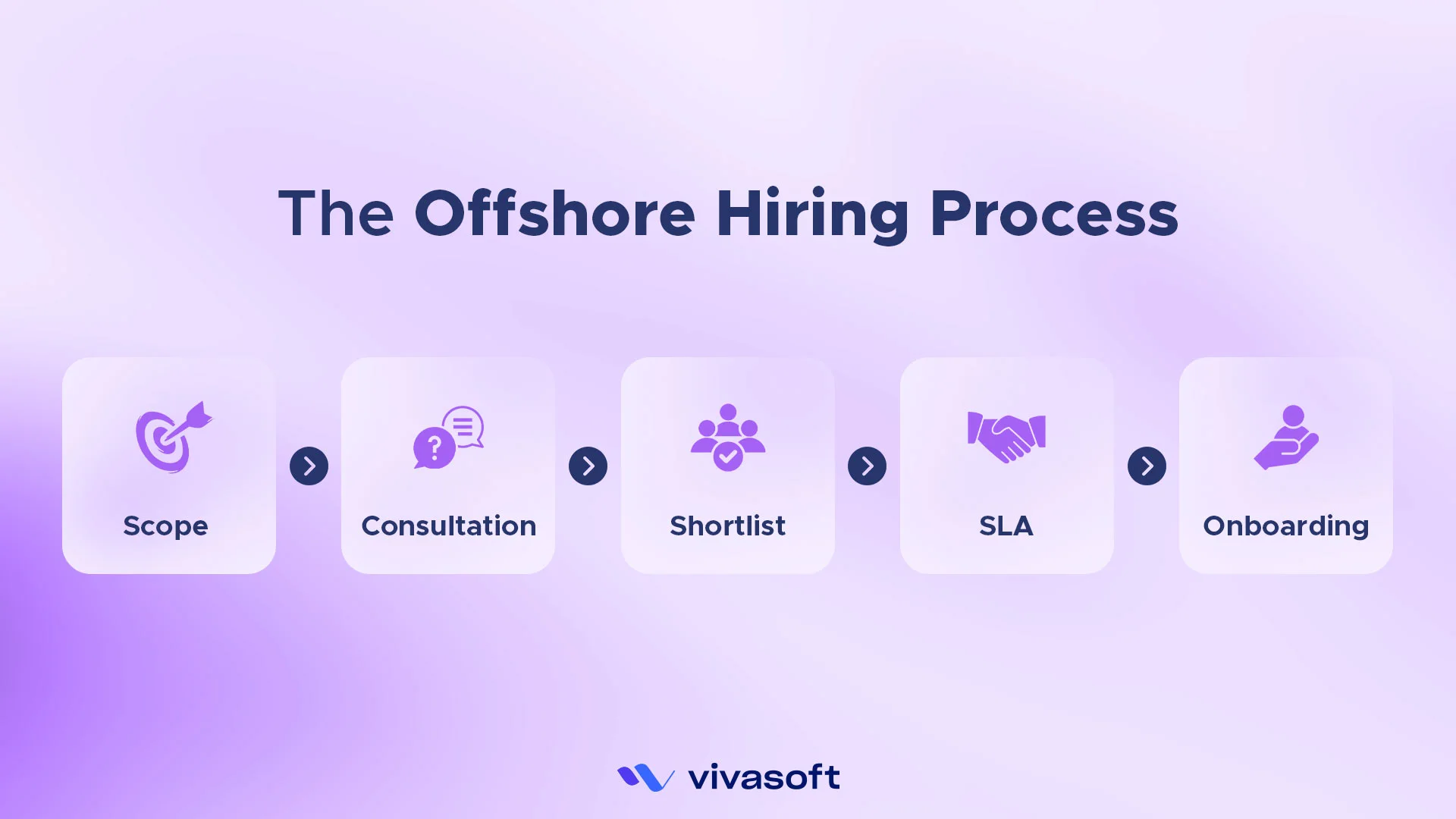
Go through the following strategies to identify the niche talent and validate real-world skills for your specific mobile app developer.
Define Project Requirements
First, you have to make a clear roadmap, highlight the app’s functionalities, target devices, and required technologies. Set a clear scope, find the right talents, and avoid costly misunderstandings later.
Source Qualified Candidates
Collect resumes and portfolios. Shortlist candidates based on relevant experience, completed projects. Assess the technical skill to ensure reliability.
Screen and Test
Now you can set up a short interview session with the shortlisted one. Request for candidates to share samples of their previous work. Ask them some relevant questions to assess their experience, like “Can you show a portfolio or live apps you’ve worked on?” or “What was your role in those projects?”
Check References and Work
Along with interviews, request contact details for previous clients and, if possible, conduct brief calls or emails asking about the developer team’s reliability. Request work samples or live apps to see the developer’s real-world output.
Finalize and Onboard
When everything is okay according to your project needs, proceed to sign the contract. The contract should cover payment terms, deadlines, and IP rights. It should also include a clear pricing structure, details of ongoing maintenance, and the tech stack to be used.
How Offshore Mobile App Projects are Developed?
Offshore development companies follow a structured modern development model to maintain the quality and speed of a project.
Agile Methodology
It is an iterative development model, where teams work in short cycles named sprints. At each sprint, they refine the codebase and improve the app functionality. Around 58% of professionals in business and tech are actively focusing on adopting agile methodologies. With Agile methods, they stay flexible and adapt to changing requirements, with timely delivery in offshore projects.
SCRUM Framework
SCRUM is the most well-known Agile framework that mainly defines specific roles such as Scrum Master and Product Owner. The Scrum Master facilitates the process, whereas the Product Owner represents stakeholders and manages the product backlog. The development team works as cross-functional professionals and tests and delivers increments of the product.
Collaboration
Offshore teams are highly skilled at maintaining clear updates and transparent workflows across teams and clients. They utilize communication tools such as Slack, Jira, video calls, and constant interaction. Also, they manage regular feedback sessions where clients can review the sprint and offer suggestions for improvement.
DevOps Integration
Teams go for a unified system called DevOps to integrate all development and operations tools into a single application, aiming to improve collaboration and visibility. They run CI/CD pipelines, automate testing to keep the app process on track. It offers faster delivery with continuous monitoring and fewer errors.
UX Design Focus
The dedicated UX designers on the team are responsible for designing intuitive, user-friendly interfaces. With earlier UX design, teams can use wireframes and prototypes quickly to collect easier user feedback.
Quality Assurance (QA)
QA is a dedicated testing section of the app development model to find and fix bugs early. Offshore QA teams run unit testing, regression testing, and plan for automation into every sprint. This helps the developers get high-performing apps ready for production.
How Much Does Offshore Mobile App Development Cost?
The pricing for offshore mobile app development is set based on project complexity, team location, and timeline. Here are the details you should know about MVP development costs:
Average Cost of Outsourcing Mobile App Development
Outsourcing mobile app developers typically costs around $55,000 to $110,000 but varies depending on the project scope and country of the offshore team.
A simple app with basic UI development costs ranges from $15,000 to $30,000 in mobile app development in the USA. As complexity grows with advanced features, real-time integrations, or cross-platform builds, the cost rises to around $150,000.
However, the average hourly rate for the offshore mobile developer typically goes from $50 to $200. In South Asia, the developer charges around $20–$35 per hour, whereas in Latin America average $40–$70. Offshore developers in Western Europe charge around $80–$120.
Factors That Influence Pricing
The overall pricing for outsourcing mobile app development varies based on the following factors.
Location of Development Partner
The hourly rate for the offshore mobile developer varies based on the region.
| Country/Region | Junior Developer | Mid-Level Developer | Senior Developer |
|---|---|---|---|
| Bangladesh | $15–20 | $25–30 | $35–50 |
| India | $15–25 | $30–50 | $50–70 |
| Nigeria | $15–25 | $30–45 | $45–65 |
| Vietnam | $18–28 | $35–50 | $50–70 |
| Poland | €25–35 | €40–60 | €70–90 |
| United Kingdom | £40–55 | £65–85 | £90–120 |
| Australia | AUD 50–70 | AUD 80–110 | AUD 120–150 |
| United States | $50–70 | $80–120 | $120–160 |
Project Scope & App Complexity
Based on the mobile app development project you are dealing with, the prices vary notably. For example, a simple mobile app (MVP) costs around $5,000 – $20,000 for iOS and Android.
On the other hand, enterprise-level apps range from $150,000 to $500,000+, depending on the intention, architecture, complex features, security assurance, and requirement for modernization.
Development Timeline
The timeline for delivering the app affects pricing. If the project is tight, the developer team may charge higher due to requiring more resources or longer working hours to meet target dates. You may need to consider paying more for overtime or additional developers. Conversely, accelerated timelines allow flexible resource allocation and working hours, which can lead to potential cost savings.
Ongoing Maintenance & Support
After launch, apps require regular maintenance for fixing bugs and adding new features. Maintenance contracts can be priced monthly or annually, and it is usually 15–20% of the initial development budget per year. This continuous QA testing keeps your app secure.
What are the Risks of Offshore App Development?
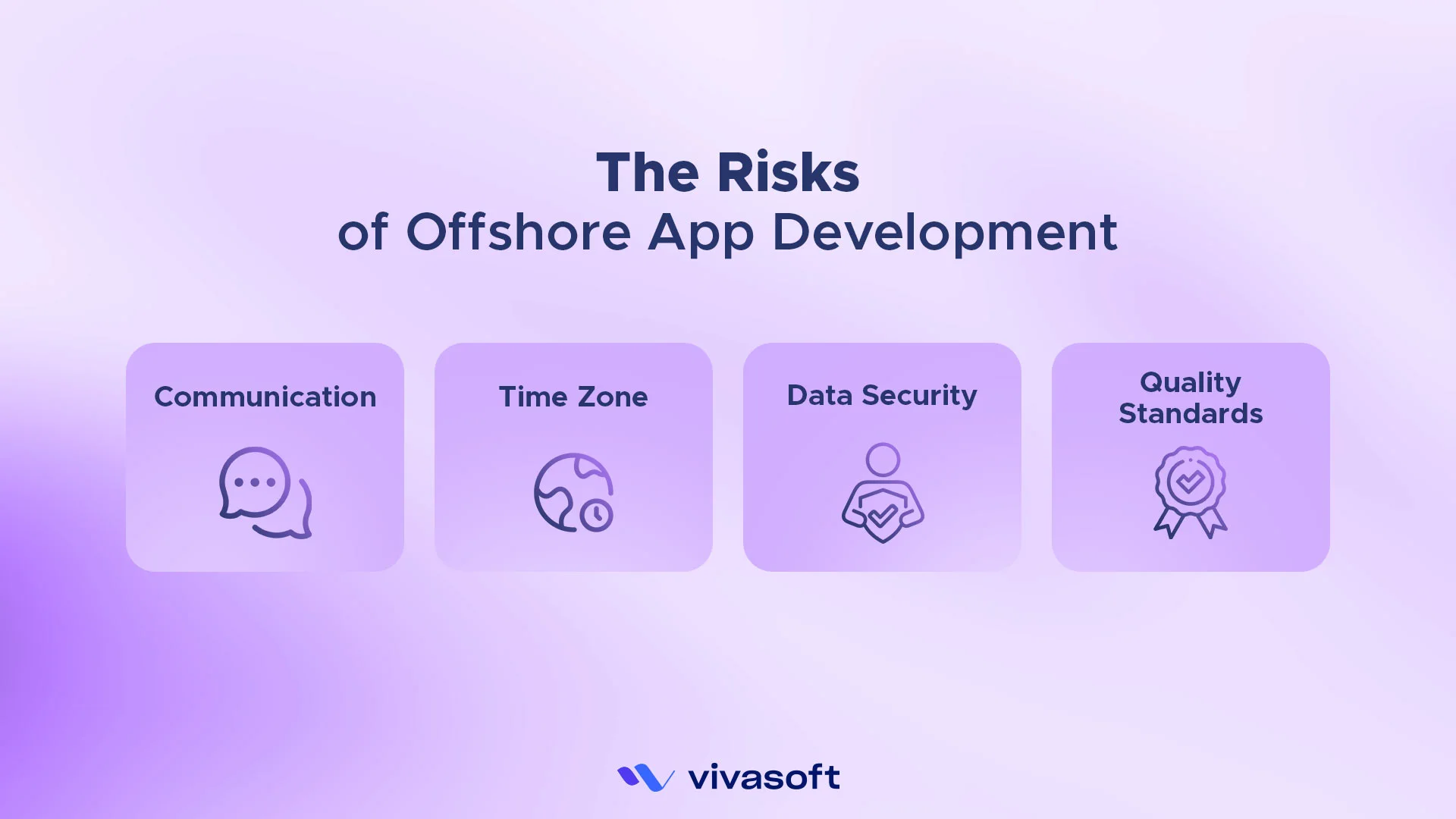
Outsourcing your mobile app development to an offshore team is not without risk and affects your project if you don’t know about to manage them effectively:
Overcoming Communication Barriers
Language gaps, cultural differences, and lack of face-to-face cues are the only reasons you may have to struggle with maintaining communication in the offshore model. Poor communication often leads to project derailments and the fear of all reworks.
Ensure that communication is always efficient using real-time messaging tools. Schedule regular meetings or maintain shared documentation to prevent communication barriers and reduce errors.
Managing Time Zone and Cultural Differences
Offshore means there will definitely be a time zone difference, but the problem arises when the gap is higher. Without proper management, differing work hours often cause delays and lateness in the important decision-making.
Cultural differences add a further hurdle. The different working style also leads to conflict and affects your project’s completion. To manage this, schedule 2–3 overlapping work hours for real-time collaboration and smoother communication.
Protecting Data Security and Intellectual Property
With strong monitoring, there is a minimal chance of data breaches and IP theft. Transferring sensitive information such as source code, API keys, or customer data carries risks of unauthorized copying or leakage.
Without clear ownership terms, you risk copyright, trademark. Failure to protect intellectual property rights often leads to liability issues. To manage this, maintain signed agreements, assign IP ownership.
Ensuring Consistent Quality Standards
With offshore outsourcing, you can access a diverse team. However, they may sometimes overlook details, leading to unexpected bugs due to integration issues. Some teams don’t even have a structured CI/CD pipeline. They fail to release updates less frequently and increase the risk of data breaches. Use automated testing and a continuous integration strategy to maintain quality and to deal with this challenge.
Best Practices for a Successful Offshore Partnership
The success rate of structured IT outsourcing projects is extremely high. To achieve this, you have to go far beyond a referral contract and communication. Here are some best practices you can watch for:
- Share clear business objectives and expected outcomes so that there won’t be any confusion.
- Collaborate with the offshore lead and break the project into sprints with timelines clearly highlighted on both sides. Maintain short sprint cycles, feedback sessions, or clean backlog reviews to keep projects on track across time zones.
- Maintain clear service-level agreements, or SLAs. Add in the deliverables, response time, and expected outcomes.
- Plan for overlapping work hours earlier to maintain real-time collaboration, no matter what the time zone gaps are.
- If possible, arrange regular workshops, updates, or demo sessions so that the team can continuously learn about your workflows or new requirements.
Industry Specific Offshore Mobile App Development
Let’s light up how businesses in different industries can take advantage of the offshore mobile app development.
Fintech
The fintech mobile app development company offers specialized financial skills that speed up the development. They seamlessly integrate the needed components and build secure apps for payments, loans, and investments. You can gain access to specific expertise, including blockchain, AI, and cybersecurity.
Healthcare
In healthcare apps, the offshore healthcare mobile app development IT experts are highly focused on maintaining the needed compliance. You can securely develop HIPAA-compliant solutions that protect patient data and offer seamless access for medical professionals and patients.
eCommerce
eCommerce business owners can hire offshore teams to develop any app, like multi-currency stores, AI-powered recommendation engines, or simple logistics integrations. You will get a powerful platform that can handle high traffic in real scenarios and ensure lower pricing.
Education & E-Learning
With offshore expertise, you can develop feature-rich learning platforms including video streaming, interactive quizzes, and progress tracking. You can add any of the smart tools that adjust to each student’s needs. Deploy the digital class faster while spending half on physical infrastructure.
Real Estate
Offshore development allows the building of property search apps, including interactive maps, listing management. With 3D walkthroughs and virtual tour features added, you can offer immersive property experiences, improve the tenant experience, and attract more clients.
Future Trends in Offshore Mobile App Development
Offshore development services are growing consistently with the new innovations. Here is what you can expect from them.
AI and Machine Learning Integration in Apps
Offshore teams are increasingly getting skilled at AI/ML and embedding the algorithms in the app. This helps improve personalization for the end users. With predictive analysis, voice recognition, and intelligent automation, mobile app development is now moving to the next level.
The Rise of Cross-Platform Development
Cross-platform development means apps are growing fast, and businesses can deploy their app on both Android and iOS using one codebase. While maintaining separate native apps is costly, cross-platform offers faster development with lower costs. By providing a consistent user experience, businesses can increase customer satisfaction and achieve higher ROI.
Cloud-First and Edge Computing Approaches
Developers are now utilizing cloud infrastructure for storage and processing. It helps businesses run their apps for the end user without slowdowns. Users can get smoother, more responsive experiences. The apps are even built flexibly to handle growing users and data without extra hardware costs.
Growth of Low-Code/No-Code Solutions
Offshore teams use low-code and no-code tools to build apps quickly. Along with reducing the development complexity, it also lessens the overall cost. For instance, they utilize OutSystems, Mendix, and Bubble to build MVPs in weeks instead of months. It makes apps far affordable for startups that are limited in budget and resources now.
Increased Focus on Cybersecurity and Compliance
Data safety has become a top priority, as data breaches are increasingly common. Offshore mobile app developers focus on encryption and secure user authentication to enhance security. Even offshore teams are now embedding the DevSecOps pipelines to ensure that your PWA meets the responsiveness standard. With continuous modernization, you can get innovation and launch-ready apps prepared for future audits.
Case Study of Offshore Mobile App Development by Vivasoft
Vivasoft is the industry-leading offshore mobile app development company serving both local and international clients across different industries. The company is trusted by 50+ global businesses for delivering scalable digital products with top 1% engineering talent. Our expertise spans cross-platform mobile apps, cloud-native systems, and complex integrations.
One of our standout projects was Hink – a Canadian social platform that we designed to solve a common challenge in event photography. Addressing the core problem, we integrated the Google Maps API so that users can find photos by location and event. We built Hink using Flutter, Golang, React, and AWS. To improve performance, we implemented multipart uploads to AWS S3. It helps the app speed up the upload time with concurrent connections. We even cared for monetization, integrating Stripe so that clients can receive payment from the customer directly. The app also included:
- Admin dashboards
- Custom collections
- Real-time search powered by ElasticSearch and Redis
The result was outstanding with:
- 40% higher user engagement
- 50% faster load times
- 60% reduction in manual communication
When Offshore Development is the Right Move?
Now, if you are preparing to launch your app, it is time to break the confusion and choose a reliable model between offshore and others.
When you should choose offshore software development:
- Need to quickly scale the developer team for your next large or urgent projects?
- Planning to implement 24/7 development cycles by using different time zones for continuous progress.
- Have budget constraints and want to lower costs but still access skilled developers.
- Specialized skills or technology expertise aren’t available locally or in your in-house team.
- Want to focus your internal resources on core business activities and assign your project to a reliable team?
- Want to reduce risk by hiring freelance or distributed teams, geographically.
When you should not choose offshore software development:
- Cultural or time zone differences could slow progress.
- Lack a clearly defined project scope and deliverables.
- Prefer frequent onsite presence for prototyping or demos.
- Have minimal tasks that demand intensive on-site collaboration.
Why Vivasoft is the Best Offshore Mobile App Development Partner for You
Developing apps by outsourcing offshore comes with real concerns. Without proper oversight, chances are the quality will drop quickly. Teams often struggle with maintaining smooth communication across time zone differences. Sensitive data and intellectual property can be at risk without strong compliance frameworks.
If you are also facing all these issues, partnering with a reliable development team at Vivasoft is a worthwhile decision for you. We are a growing IT company, having a proven track record for building scalable, secure, and high-performing mobile applications. Here is where we truly stand out:
- Optimal Value for Your Investment: We let you access world-class talent at competitive offshore rates so that you can ensure maximum ROI and cost efficiency.
- Seamless Collaboration & Communication: With agile frameworks, expertise in offshore operations, and robust project tools, we are dedicated to making our team work efficiently.
- Access to Top-Tier Talent: We provide engineers from the top 1% worldwide, with expertise across modern tech stacks.
- A Culture of Quality and Precision: Starting from structured testing to CI/CD pipelines, we maintain strict quality standards that maximize performance.
- Ironclad Security & IP Protection: We apply globally recognized security practices and follow strict data protection regulations. Our team implements IP safeguards that keep your information safe.
- Transparency That Builds Trust: With clear reporting, SLAs, and open communication, our team provides constant updates about project progress and any arising issues.
Conclusion
For businesses that really want to accelerate growth, offshore mobile app development brings a great advantage. You can connect with skilled global talent capable of delivering high-quality solutions at reduced costs. This model not only accelerates your product’s time-to-market but also provides the flexibility to scale your team as your project demand grows. You can easily mitigate risks and ensure an outstanding product outcome. Be sure to partner with trusted and experienced offshore mobile app development companies to get everything managed professionally.
FAQs
How long does it take to build a mobile app with an offshore team?
It usually takes 3–6 months for a standard app for an offshore team. But if you are building an enterprise-level app having complex and more integrations, the time would be 6–12+ months.
What happens if the offshore company misses deadlines?
If the company misses the deadlines, it means you face delays in the app launch timeline and miss the market opportunity. Look for companies that follow SLAs and use milestone tracking to ensure timely delivery.
Are language and cultural differences a big barrier when working offshore?
Language and cultural differences can affect your overall concerns if you are dealing with unreliable companies. They can slow communication and create misunderstandings. Working with teams that have strong English proficiency and use standardized documentation can minimize these challenges.
How do I communicate daily with an offshore development team in another time zone?
You can easily manage efficient communication with the team by using tools like Slack, Jira, or Zoom. Schedule for daily or weekly check-ins to track everyone’s progress and get the updates.
Is offshore mobile app development only for big companies, or can startups also benefit?
Along with big companies, even startups or any industry can benefit from the offshore mobile app development company. You can access their skilled team at lower costs and build MVPs faster. Also, startups can easily scale their teams flexibly without the heavy overhead of local hiring.
How do offshore companies ensure my app is published correctly on the App Store and Google Play?
The offshore team precisely handles all the related technical tasks. They maintain strict store guidelines to correctly publish the app on the App Store and Google platforms. They also manage app submission, metadata, screenshots, and updates to have a smooth approval.
How do offshore teams handle app scaling when my user base grows rapidly?
The team mainly uses scalable cloud infrastructure that grows with the rising user base. They optimize databases, run load tests, and adjust architecture to keep performance smooth.
Do offshore developers provide post-launch support and app updates?
Yes, reliable offshore development teams typically provide post-launch support and regular app updates. They help you fix bugs, release new features, and ensure your app stays updated.