An MVP lets you test your business idea’s core value quickly. The best part, you can minimize the costly mistakes before full-scale development. However, the success lies in sharp budget planning and a focus on the core feature that will provide real value to the users. MVP development helps businesses avoid wasting resources and time. You will get the fastest and actionable market feedback without burning capital on unnecessary features or inefficient workflows.
So, to build your next smarter, faster, and more cost-efficient MVP. This article will guide you through all the related information about MVP development cost and tips for proper budget management.
What Is an MVP and Why Should Startups Build One?
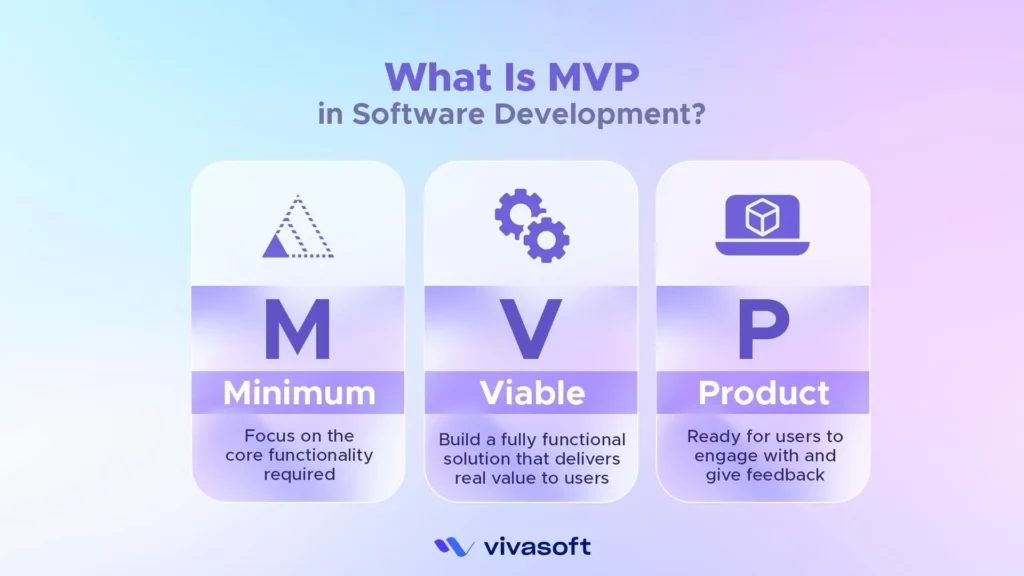
An MVP is the simplest version of the main software product with just enough core features to solve a specific user problem. Businesses basically release it to validate the product-market fit.
With MVP development, the main features are deployed in the initial phase. Thus, startups can identify whether it meets users’ needs and collect real feedback fast. Building an MVP reduces the risk as it helps avoid wasting months on features no one wants.
You are likely to spend less money up front and can identify errors or market changes early. With each iteration, it likely offers refining opportunities for the core functionalities, such as onboarding, user retention flows, and payment systems.
How Is MVP Development Cost Structured?
The MVP cost can be calculated based on these effective structures:
Pre-Development Costs
Before you start, you need to go through a clear and structured pre-development phase. First comes market research, including surveys and interviews, which usually cost between $1,000 and $10,000. Next is business analysis, where you can expect to pay $2,000 to $5,000.
This is the phase where you can define the value proposition, target segments, and core KPIs. Then comes wireframing and planning, which transforms your ideas into life using visual sketches. The process typically costs around $500 to $5,000.
Core Development Costs
Core development covers the largest share of your total MVP development cost. Start with the front and backend development that usually costs between $10,000 and $40,000. It helps to build responsive interfaces. Backend handles the server logic, APIs, and security.
Next is the database and server infrastructure that costs around $2,000 to $10,000, where developers likely build the storage architecture. Finally, for third-party integration, which adds $1,000 to $20,000 to the budget.
Design and UX Costs
Design and UX costs for your MVP cover starting from wireframing to prototyping and core branding. Expect to spend around $500–$2,000 for basic wireframes from an offshore team, and it can extend up to $5,000 if you have worked with the local agencies.
For prototypes including clickable paths, animations, and feedback functions, add about $2,000–$10,000 to your core budget. Moving to UI/UX design, here you will be charged about $5,000–$20,000, depending on complexity and designer experience. Lastly, for branding, like making logos or color schemes, designers charge about $1,000–$3,000.
Testing and QA Costs
During MVP development, you must test the process that includes manual and automated testing, plus performance and security assessments. For manual testing through QA engineers, you can expect to pay around $3,000 to $10,000, depending on product complexity.
Automated testing adds about $5,000 to $15,000 to your main budget. When all is done, QA engineers run the performance testing. Expect this QA phase to be complete, including security audits between $2,000 and $15,000, typically spanning 2 to 4 weeks.
How Can You Calculate the Cost of MVP Development?
To calculate the MVP development cost, first you have to develop the overall process in a few manageable phases. Start by defining your MVP’s essential features and core functionalities. Now break down each feature into the needed technical stack. Such as UI design, frontend logic, backend API, and database setup.
This way, you can cover everything and reduce the chance of resource wastage. When these are all done, now it’s time to give time to testing. It includes both manual and automated checks, alongside performance and security evaluations.
When doing all these, make sure you are not missing business analysis in the pre-development phase. When that framework is ready, calculate the estimate of the time and resources for each task. You can utilize the MVP calculator to manage this budget estimation task effectively.
Add all these calculated costs at every phase and get the total. Include a contingency buffer of about 10–20% to cover unexpected costs. For a more accurate breakdown, try our MVP Cost Calculator.
How Much Does MVP Development Actually Cost?
MVP costs typically vary by complexity, from simple apps with basic features to complex products with advanced functionality.
| MVP Type | Estimated Cost | Common Features | Example App Type |
|---|---|---|---|
| Simple MVP | $10K–$30K | Basic UI, one core feature, static content, minimal backend | To-do app, booking form |
| Mid-tier MVP | $30K–$60K | User accounts, payment system, admin panel, dashboard, basic analytics | E-commerce store, SaaS tool |
| Complex MVP | $60K–$100K+ | Real-time data, custom backend, API integrations, multi-user roles, strong security | Fintech app, AI SaaS platform |
What Are Some Real-World Examples of MVP Costs?
Below are examples of some real-world MVPs with their cost estimation:
1. SuperTracy
In 2024, PostNL, the biggest parcel and e-commerce company in the Netherlands, launched a basic AI-based MVP called SuperTracy. This system uses generative AI and makes parcel tracking easier and clearer.
It autonomously handles a wide range of user inquiries related to parcel tracking and improves the user experience. The model is designed using a multi-agent large language model (LLM) framework, including LLAMA 3 and GEMMA 2. You can expect to spend about $50K–$150K to build such an AI-based MVP.
2. Product Hunt
Ryan Hoover launched Product Hunt as a simple email digest. Instead of building a full app, he used a link-sharing tool called Linkydink and developed a group where enthusiasts could share and discuss new tools they discovered and liked.
It took a very minimal time to set up, and subscribers received daily emails with the list of products. Over time, Product Hunt evolved into a full-featured platform, where users submit, comment, and vote for products. An estimated cost to develop such an MVP would be $10K–$30K.
3. Dropbox
Dropbox launched a simple explainer video that showed how its cloud storage worked. Instead of building a full product, the video was enough to explain the concept and benefits clearly. It quickly attracted the attention, feedback, and investor interest Dropbox needed to move forward.
The video went viral very quickly and grew their waitlist from 5,000 to 75,000 users overnight. The cost to build such an MVP would be minimal, often under $10K.
What is the average MVP development cost in 2025?
The average MVP development cost ranges broadly depending on complexity. But at the practical estimation midpoint, it can range between $40,000 and $80,000 for most web or mobile apps.
For instance, a very basic app built for buying/selling online, with product listings and carts, can cost around $10K–$30K. But apps with stronger security, payment, and compliance features will go up to $30K–$60K.
Can I build an MVP for less than $10,000?
Yes, you can build an MVP for under $10,000, but the options are very limited. Within this budget, you can develop the most basic products, typically with a single core function. For example, you can develop simple landing pages to test the user interest or minimal booking tools.
However, for cost savings, you can use no-code platforms and open-source templates. Also, you can hire offshore developers to build an MVP within your budget.
What Key Factors Influence the Cost of MVP Development?
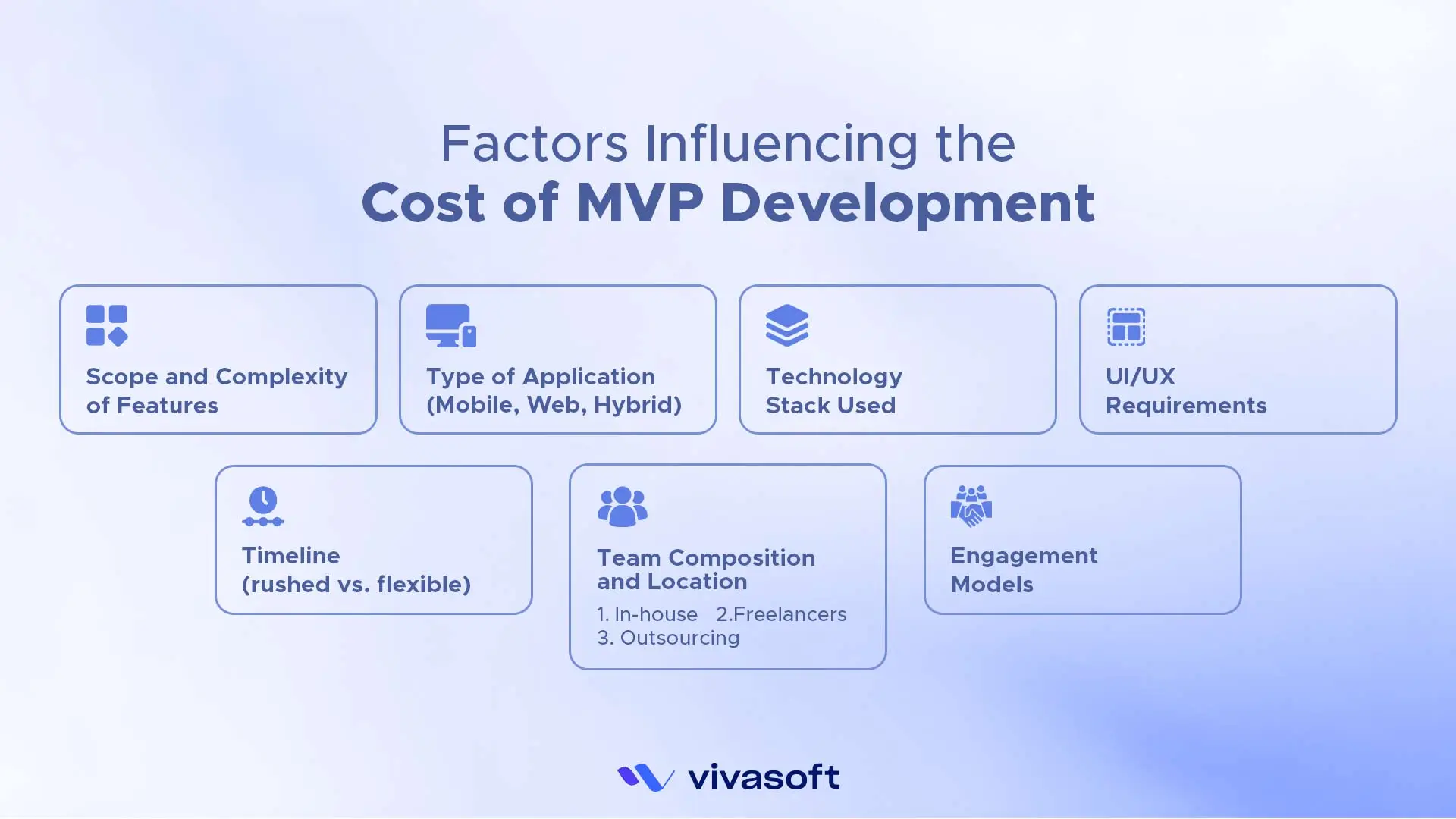
Key factors influencing MVP development cost include product complexity, number of features, technology stack choice, team structure and location, development timeframe, and so on:
Scope and Complexity of Features
Complex functionalities in developing an MVP, such as real-time data, custom algorithms, or secure payments, require special skills. It increases your upfront budget. The more features you add, the more code, APIs, logic layers, and UI components you’ll need. It impacts the set development hours and budget.
Type of Application (Mobile, Web, Hybrid)
The platform for the application directly affects the complete MVP structure and tools stack you will choose. The native app requires separate development for iOS and Android. Web apps are typically faster and cheaper, and can be developed in React or Angular.
Lastly, hybrid apps are complex enough and require specific tools and frameworks. Often it uses shared code for multiple platforms, reducing cost but sometimes limiting app performance compared to native builds.
Technology Stack Used
If you go with the widely used technology stack such as MongoDB, Express, React, and Node, it reduces the cost and speeds up the delivery time. On the contrary, some advanced toolsets like Elixir for real-time apps, enterprise-level security, or blockchain frameworks require niche expertise and increase the hourly rate as well.
Some of the specialized apps need more configuration. For example, microservices architecture increases complexity compared to a monolithic one.
UI/UX Requirements
The UI and UX requirements of your MVP development have a direct impact on the costing. If you prefer to have a basic interface with minimal screens, it needs simpler frontend coding, which simply reduces the cost. But if your app has custom animations, interactive flows, and micro-interactions, the design hours increase fast, as well as the development cost.
Timeline (rushed vs. flexible)
The timeline for MVP development directly influences cost and quality. If you rush your MVP development, you’ll need more developers working at once, often with overtime. It increases the overall costing and leaves several bugs and technical debt due to rushing.
A flexible timeline avoids these trade-offs. Partner with a small but skilled team that performs full testing and builds scalable architecture. This results in lower cost.
Team Composition and Location
Choosing the right team composition based on location greatly impacts your MVP’s success and cost. Here are three options you can go with:
- In-house: With the in-house team, you can get the full product for your product development with time flexibility. But you need to consider HR costs, workspace, and tech infrastructure. It’s ideal when you’re building a long-term product with an evolving roadmap.
- Freelancers: Freelancers typically work on short-term projects and charge per hour or per project. It reduces the fixed cost but leads to delivery delays. Often, you need to work with multiple freelancers from different locations, which creates inconsistent coding standards or delays in integration.
- Outsourcing: Coming to the outsourcing, you have two flexible options, onshore and offshore. Through offshoring, you are likely accessing the global combined talent within your budget. If you maintain consistent communication and a time zone gap, it is a great option to get the project done with ultimate quality assurance. With the onshore, you can ensure clear coordination, but often end up with higher costs.
Engagement Models
The fixed price model sets a total cost upfront, ideal for projects with clear deadlines. You pay a fixed amount based on the time spent. The time and materials model bills based on the actual hours worked and resources used. It is best for projects with changing requirements. You will get more control during the iteration.
Why Is Budget Planning Crucial for MVP Development?
A proper budget planning keeps your MVP lean and perfectly aligns with the business goals. Without a proper budget manager, you leave yourself a risk of overbuilt features or may run out of funds mid-project. But with a clear budget, you can easily skip these risks and focus on only the features that solve your core user problem.
Moreover, you can effectively map out the available resources, such as developers, tools, and timeline, according to your MVP goals. It also helps you spot and prepare for risks early.
What Costs Should You Expect After Launching an MVP?
After deploying the MVP, there are still several costs that you may need to consider:
- Marketing and Advertising Costs: After launching, you will need to prepare for marketing it with targeted campaigns. It helps drive traffic and user acquisition. Initial marketing can cost anywhere from $5,000 to $20,000 monthly.
- Sales Tooling and Funnel Optimization: To convert your visitors into paying customers, you need to optimize your sales funnel. For this, expect to invest $5,000 to $10,000 initially on funnel setup.
- Ongoing Maintenance and Support: Your MVP requires regular updates for bug fixes and security patches. Set aside about 15–20% of initial development expenses for maintenance annually.
- Legal and Compliance Expenses: As users grow, so do your legal responsibilities. So you need to budget for legal audits and data privacy regulations. Legal consulting can cost from $2,000 upwards, depending on the complexity.
- User Feedback and Iteration Cycles: After launch, you’ll collect feedback through surveys, interviews, and usage analytics. Also, allocate a budget for testing tools and interactions in a few phases.
How Can You Reduce MVP Development Costs Without Sacrificing Quality?
By focusing on iterative development and strategic resource allocation, you can maintain the quality of your MVP while staying within budget.
- Prioritize Only Must-Have Features: Use the MoSCoW method to classify the features into Must-Have, Should-Have, Could-Have, and Won’t-Have ones. This helps you to invest in Must-Haves to deliver core value rapidly.
- Use No-Code/Low-Code Tools: No-code and low-code platforms speed up MVP development. It helps to build functional products with minimal custom coding. You can reduce the development time and cost.
- Use Open-Source Components: Integrate reliable open-source libraries and frameworks to save development time and avoid licensing fees. Well-maintained open-source tools reduce the need to build from scratch and save costs.
- Choose the Right Development Region: Choose to outsource your project to the offshore team to ensure the best quality at a minimal budget. Offshore teams deliver technical expertise affordably when managed efficiently.
- Start With a Clickable Prototype or Concierge MVP: Begin by creating a clickable prototype or a concierge MVP. This approach helps you to test the core concepts with minimal development investment.
- Use Pre-built UI Kits and MVP Frameworks: Utilize the pre-built UI kits and MVP framework that offer ready-to-design components and backend structures. It accelerates development and reduces cost.
What Are the Common Cost Traps in MVP Development?
Common cost traps in MVP development include building standard components from scratch, choosing niche or complex technologies, poor timeline planning, weak project management of freelancers, or ignoring user feedback. Often, only the lack of post-budget planning leads to costly bug fixes and delays in product launch. To better understand the obstacles behind these cost issues, check out our guide on MVP development challenges.
How Long Does It Take to Develop an MVP?
MVP development typically takes 4 to 16 weeks. Simple MVPs can be launched in 4–6 weeks, while complex ones take up to 12–16 weeks. However, this timeline may vary based on the feature scope, the developer team size, the tech stack you are choosing, and the development model. Typically, complex features, integrations, larger teams, and iterative feedback cycles extend this timeframe.
What Tools Can Help You Build an MVP Faster and Cheaper?
Building an MVP quickly and affordably depends on using the right set of tools for each development stage.
No-code builders
If you want to create full web or mobile apps without writing code, some no-code builders like Bubble and Glide offer drag-and-drop builders, built-in databases, and third-party plugins. You can utilize them for rapid prototyping or even live MVPs when you are running on a tight budget.
Design tools
Some design tools like Figma and Adobe XD help to create UI/UX designs and interactive prototypes. Figma is easy in real-time team collaboration, live device previews, whereas Adobe XD offers advanced prototyping features such as voice command or auto-animate.
Project management
To manage the project, you choose Trello or Jira. Trello provides easy visual task boards suited for small teams. Besides, Jira is great for complex projects, offering detailed sprint planning and backlog management.
API integrations and automation platforms
Platforms like Zapier help connect multiple apps and automate repetitive workflows without coding. Automations reduce the manual work and minimize errors.
How Do You Choose the Right MVP Development Partner?
The company should have proven MVP experience, industry-specific knowledge, and strong technical skills in relevant technologies. These are green flags to choose one. Some of the red flags to note in this case include vague or generic proposals, unwillingness to discuss MVP strategy, lack of a relevant portfolio, poor communication, or slow response.
Create a checklist to assess industry expertise, technical skills, communication process and development methodologies. Also, check the relevant portfolio with references and the ability to manage scope changes.
While interviewing the chosen companies, consider asking the following questions to evaluate their capabilities and fit for your project:
- What features are essential for the MVP?
- What is your development budget and timeline?
- How do you manage scope changes during development?
- What development methodology do you use?
- How do you ensure product quality and testing?
- Can you provide references or case studies of past MVPs?