An MVP is the simplest version of a product, where you have to test your core idea and validate data all by yourself. The evolution of AI has changed this process completely. Using advanced algorithms, models learn from user data and improve automatically.
Traditional MVPs often take months to develop, yet there’s still a risk of delivering features users don’t actually need. With AI MVP development, validation gets faster through predictive analytics and automated testing. By identifying issues early, there’s no wasted R&D time or costly rework.
In this AI MVP development guide, we will disclose how to build AI MVPs and validate product-market fit faster.
What Is an AI MVP?
An AI MVP is the revolutionized minimal viable product that is developed by integrating machine learning models or neural networks to validate your core concept. Where the traditional MVP relies on static features, AI MVPs process the data dynamically through algorithms.
Businesses can test the market demand for their product with intelligent automation. For instance, you can use predictive analytics to understand user behavior. There are various recommendation frameworks that help personalize your content. Also, NLU-powered chatbots handle conversions and respond to users’ queries in a way that feels natural and engaging.
In 2025, the era when AI innovation is redefining business models, an AI MVP lets you build an enterprise-grade, smarter product at supreme speed. You can collect behavioral data faster, understand real user demand, and automate iterations based on model performance. All in all, an AI MVP development lets you deploy a product with the ultimate technical precision.
What Makes Building an AI MVP Worth It Beyond Just Speed?
Beyond just launching fast, AI MVP becomes smarter with every user interaction. Using real usage data and personalized user experience, AI lets you automate improvements and validate product market fit. The model improves by itself, providing competitive advantages than traditional MVP development.
Data-Driven Validation Instead of Guesswork
AI MVP logs every interaction as training data. The model generates probability scores for each action, starting from clicks, purchases, or drop-offs. AI predicts how likely each action is to happen. The system runs A/B tests on different algorithm parameters automatically to find which performs best.
This way, it detects complex data patterns, like which user behaviors lead to cancellations that humans might not notice. You will be notified of every notable factor that affects your desired results. Thus, no chances of guesswork and eventually no errors.
Smarter User Insights with Predictive Analytics
Various predictive models are mainly utilized to analyze user behavior sequences and predict their future actions. Take an example of Gradient Boosting algorithms. It helps identify customers who are likely to complete a purchase by analyzing their online activity. With cohort analysis, you can group users with similar behaviors and understand trends over time.
You can predict lifetime value before users complete their second session. There are also some models, such as random forests, that find and group users into categories based on the likelihood of certain actions. Moreover, anomaly detection flags unusual behaviors that could indicate opportunities or problems.
Efficient Iterations through AI-Powered Automation
AI integrated in the MVP updates itself whenever it gets new data, and keeps the learning loop continuous without human intervention. The system updates predictions without writing new code or taking the system offline. Various AutoML systems are utilized to try out different ways to structure and train the models and find what works best.
You will get the best-performing setup in hours instead of weeks. The AI even automatically adjusts technical settings in the model and improves the learning sessions. It validates prediction accuracy before going live and autonomously fixes issues.
Competitive Advantage via Intelligent Product Features
AI makes it possible to embed machine learning directly into your product’s core functionality. Therefore, your users get personalized experiences and improve the adoption level. The recommendation framework learns individual choices and shows each user content they’re most likely to engage with.
Users can find the most relevant articles and products for them and improve the engagement level. Among those, natural language processing makes further interactions smarter and more natural. Even computer vision is utilized to analyze images and sentiment analysis for feedback processing.
Scalable Foundations for Future Growth
You can build an MVP on some popular cloud AI infrastructure like AWS SageMaker or Google Vertex AI. All these help scale compute resources up or down based on your customer count. The part that processes data is separate from the part that delivers predictions.
So it is easier to update or change algorithms, and you can replace AI models quickly without starting over. As the user base grows, you can extend capabilities by adding new models or retraining datasets. You can even keep track of every dataset and model version, so nothing gets lost and experiments are reproducible.
Step-by-Step Guide to AI MVP Development
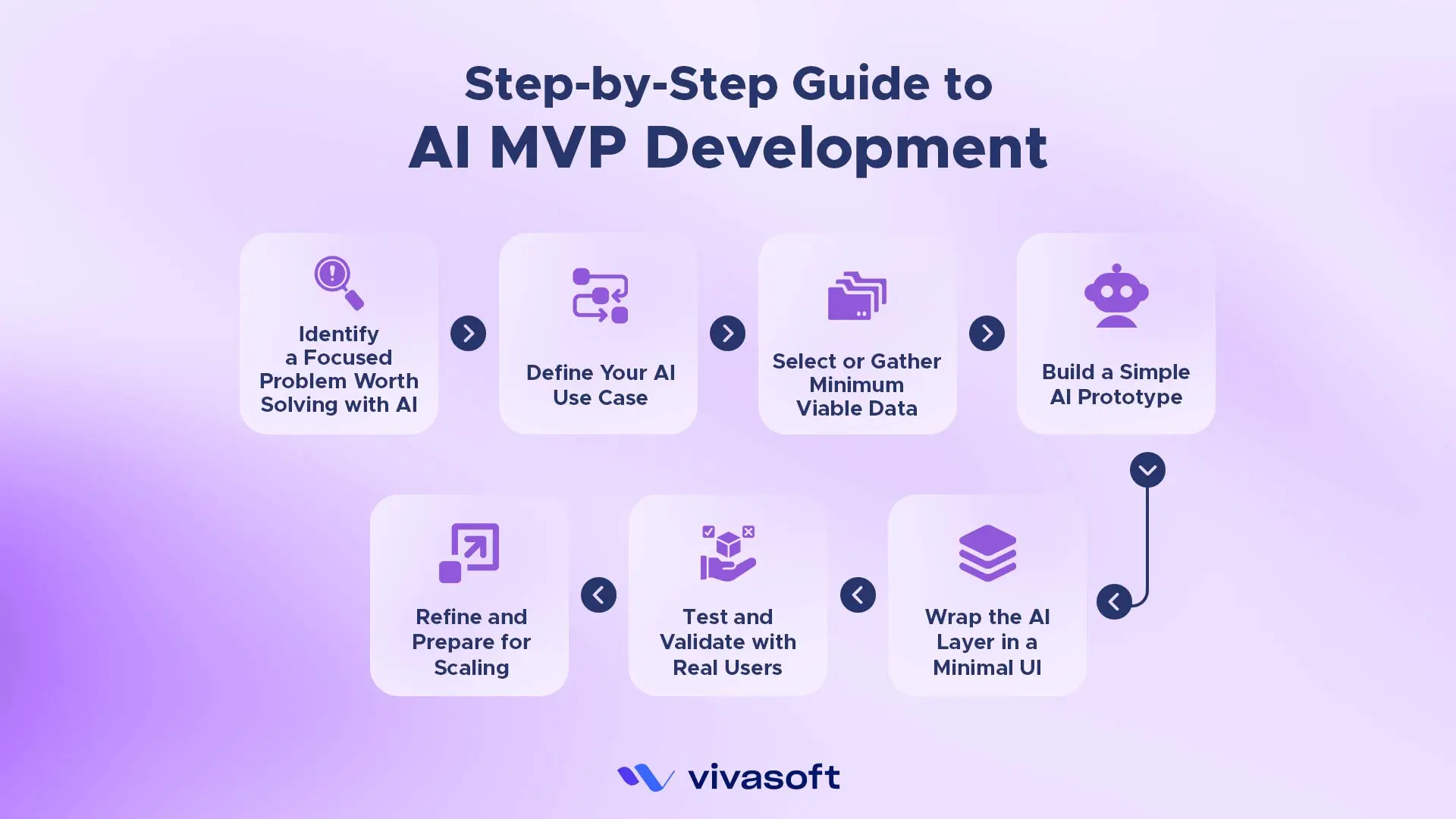
Developers go through a structured planning and technical precision to build an efficient AI MVP. Here is the quick overview of all the steps you should know about:
Step 1: Identify a Focused Problem Worth Solving with AI
As for the first step, you have to find a specific problem where AI creates measurable value. For insurance, ask yourself: Does this problem generate continuous data? Or will AI actually do better than simple rules?
Also, identify whether the results make a visible impact on users immediately. Next, validate that you can collect quality training data. Therefore, pick problems where data already exists, or you can generate them naturally through user actions.
Step 2: Define Your AI Use Case
At the next step, pick a problem and start working on it with the cooperation of AI. For example, AI will predict which users will stop using the service in the next 7 days. Specify your model’s input and output clearly. Note that each of the tasks needs different algorithms and architectures.
Then set the success metrics before building anything and define the minimum performance needed for the AI to actually be useful. You can establish baseline performance from current non-AI methods so you can justify the investment. It will even help you know when your AI MVP actually works better than simpler alternatives.
Step 3: Select or Gather Minimum Viable Data
When the model selection is done, now time to collect data to train your model. The model’s performance depends entirely on data quality and quantity. Start by auditing existing data sources.
It would be user logs, transaction records, and customer interactions. Collect data from it and determine if it is enough for the AI method you plan to use.
Complex AI models will require more data, while simpler models can work with less. In case you don’t find data for now, you can find ways to start gathering it immediately. For this, set up the tracking event.
Step 4: Build a Simple AI Prototype
After training the model, you move forward to build an AI prototype. It is likely a simple and basic code version using pre-trained models or simple algorithms. You can start with some pre-defined libraries, such as scikit-learn for classification or Hugging Face transformers for NLP tasks.
Don’t build custom architectures right now. You just have to fine-tune existing models on your specific dataset instead. This makes your work process simpler and faster. Additionally, focus on the core problem now that you want to solve and skip the untested features. This way, you will learn faster, reduce errors, and avoid resource wastage.
Step 5: Wrap the AI Layer in a Minimal UI
Now is the time to connect your model to a user-facing interface where people interact with predictions. For this, you can start with a simple web app using some proper frameworks, such as React or Streamlit, for quick deployment.
But the UI should display the features in a user-friendly way so anyone can easily interact. There should not be any technical jargon or confusing terms. Also, your model should be trained enough for input validation so that any wrong information can’t break the model’s performance. Set up a feedback system so users can give information about their experience.
Step 6: Test and Validate with Real Users
When the UI with the end features set up is done, deploy your prototype to a small group of actual users. For that, you can select 10-20 people from your target audience who face the problem daily.
After deployment, you must track how they interact with your AI features specifically. Note down where users agree with the AI’s predictions and where they reject them. For all these, collect qualitative feedback through user interviews. Using the feedback and results, you can decide what to fix, improve, or focus on next.
Step 7: Refine and Prepare for Scaling
Finally, analyze all the usage data and model performance metrics to find room for improvement. Then, check and find out specific parts or user groups where your AI predictions became less accurate.
Use the real data and train the model again so it improves. As needed, you will have to optimize inference speed by using smaller or simplified models that run quickly. Additionally, you can set up monitoring dashboards that track prediction latency and error rates continuously. This way, you can implement A/B testing infrastructure and compare model versions safely.
How Much Does It Cost to Build an AI MVP?
You can expect to spend typically between $30,000 and $150,000 to build an AI MVP, depending on your approach. The price also varies depending on model complexity, dataset quality, and infrastructure demands. For a more accurate estimate based on your project details, try our MVP Cost Calculator.
Here is the quick cost detail of typical cost ranges across MVP tiers:
.
| Type | Estimated Cost (USD) |
|---|---|
| Low-Cost AI MVP | $15,000 – $30,000 |
| Mid-Range AI MVP | $30,000 – $80,000 |
| High-End AI MVP | $80,000 – $200,0001 |
How Do Startups Reduce Costs in AI MVP Development?
The cost range also varies based on how much customization your product requires. If you want to reduce costs, you can go with early prototypes built with pre-trained models. It costs less than advanced systems using custom algorithms.
You can budget to build an AI MVP with pre-trained models and open datasets starting around $30,000. Besides, custom models with proprietary data raise costs to $150,000. Also, your big expenses are AI engineer salaries that are about $80–$200 per hour.
It is recommended to partner with specialized AI development companies. This will be cost-efficient compared to hiring full-time engineers or managing freelancers individually. You can easily save a lot by working with experienced teams without recruitment overhead or long-term salary commitments.
How AI Enhances the MVP Development Process?
AI has a big part in enhancing your MVP development process. It facilitates automatic improvement cycles. The system automates all the related tasks such as collecting user behavior, updating models overnight, or if you want to deliver better predictions without manual updates. For all these, you can skip building complex rules manually.
The trained model learns patterns directly from data. Another advantage is that the system tests thousands of interface variations simultaneously. No matter how large your customer base is, AI perfectly aligns with each conversion.
Lastly, with a continuous feedback loop, you can reduce months of user research into just weeks. The algorithms group similar responses and detect sentiment trends across thousands of comments. This gives you the flexibility to iterate based on measurable patterns rather than just guesswork.
Which Tools and Frameworks Should You Use to Build an AI MVP?
Here is the list of the needed tools and frameworks that developers utilize to build a well-performing AI MVP.
Pre-built APIs and SDKs
Some of the pre-trained APIs help to prototype fast. You can connect OpenAI APIs to integrate advanced language and vision models. Besides, Google Vertex AI lets you train custom models on the given data. Amazon SageMaker, offered by AWS, works as a fully managed server. It simplifies the process of building, training, and deploying machine learning algorithms.
Low-code/no-code AI Platforms
Those who are not technical experts can utilize some low to no-code platforms to design AI workflows through drag-and-drop components. These platforms help manage and automate model training, validation, and deployment. You get working APIs without coding machine learning algorithms yourself.
Data Labeling Tools for MVP-Scale Training
While building an early-stage AI prototype, some advanced tools are utilized to tag or label data faster and more accurately. These include Labelbox, Scale AI, and SuperAnnotate. For small MVPs, these tools improve dataset consistency and help in efficient iteration on trained learning models.
A/B Testing & Analytics Tools
A/B testing tools are must have when you want to compare two or more versions of a feature and analyze which one performs better. For instance, Mixpanel and Amplitude track behavioral data and visualize funnels. You can find out which AI predictions actually work on the users’ actions.
What Are the Key Metrics to Measure AI MVP Success?
After MVP development, you need to measure the success to ensure whether AI creates actual value for users and revenue. You can easily track the model performance by measuring accuracy, precision, and recall. Measure Daily Active Users, or DAU, to know the condition of the engagement. User retention rate is another important metric that helps you identify how many users continue using your MVP over time. An efficient product maintains about a 25–30% retention rate after 90 days.
Alongside these metrics, focus on the conversion rate. It shows how many users complete key actions such as signing up, subscribing, or making a purchase. The bounce rate will identify usability friction. You will get the percentage of users who leave without taking action. A higher rate means an unclear feature value.
\Other key metrics include customer acquisition cost to measure spending efficiency and net promoter score to track the visitors’ loyalty to the brand. Focus on CLV and ARR to evaluate the revenue stream of your product.
How Do You Choose the Right AI MVP Development Partner?
To make the AI MVP development process efficient, the first thing you need is a partner with expertise in both machine learning and lean product validation. Choose an MVP development company with a strong track record in AI and successful MVP launches.
Review their portfolio for AI MVPs that have delivered measurable results. Ask about their data handling processes and model training capabilities. Additionally, assess their communication style and MVP development methodology.
Note that agile teams iterate faster and adapt to feedback efficiently. Vivasoft has met all these criteria efficiently. We have a team of 300+ engineers and have already delivered AI-powered MVPs for global clients. Schedule a consultation today to discuss your AI MVP development requirements.
Looking to explore more options? Check out our detailed guide on the Top MVP Development Companies to compare leading partners and find the one that best fits your project goals.