The mobile app industry is massive, and it’s accelerating faster than ever. The app development industry generated revenue of around $935B in 2024. It is projected to grow to US$145 billion in 2025.
Experts are forecasting this data to reach about US$1 trillion by 2026. Users are preferring apps with edge-AI features and 5G-powered experiences that feel smarter and faster.
Consumers expect quicker purchase flows across every mobile category. As demand grows, companies face tighter competition. However, this also offers new opportunities for both developers and businesses. Teams can respond faster with the perfect utilization of the trends. Read on to have a clear overview of the top 10 mobile app development trends for 2026.
Key Takeaways
- An AI-first personalization feature is leading the development industry, especially to boost engagement.
- Edge AI reduces latency and bandwidth costs. It makes it possible to run heavy models directly on devices.
- 5G-powered apps offer faster and more interactive experiences on mobile devices.
- Companies focus on developing apps that safeguard sensitive data efficiently.
- Use hybrid monetization models to get higher revenue while ensuring the best user experience.
- Developers can turn to the low-code platforms to accelerate development phases.
So, what should be your next step? Check out the trends listed in our article and adjust your app development strategies.
To make the process easier, you can partner with a skilled mobile app developer team from the beginning so they can help plan the architecture.
What are the Latest Mobile App Development Trends?
Let’s unfold all the emerging technologies that will transform the mobile app development world in 2026.
1) AI & On-Device ML (AI-powered personalization, predictive analytics, data-driven apps)
AI-powered personalization has just changed the user flows by offering real-time intent detection. A major advancement you should know is the use of on-device machine learning models. It makes it possible to run the app directly on the preferred devices without depending on cloud servers.
This offers superior privacy, removes delays, and helps apps keep users longer. What’s more? Predictive analytics now catches even micro-behaviors of the users and adjusts the interface. Developers are embracing these changes.
As per the recent “State of AI” 2025 survey reports, up to 88% of organizations use AI in at least one business function. This raises a question: “Will AI replace app developers?” It’s a big NO. Instead, it will level up their productivity and offer smarter task completion with solid human judgment.
2) Edge AI & Edge Computing Infrastructure (real-time processing)
The architecture is continually changing from centralized servers to edge nodes. That means mobile app development companies now place these small computing units closer to where the data is created, like phones or local devices.
So, AI services sit near the user, not miles away. Why? It’s faster and reduces internet dependency. For example, edge AI in a Jetson Nano processes video in ~22 ms, while sending it to the cloud takes ~150 ms.
But you have to consider some upfront costs. The system might need specialized hardware or local maintenance. This even makes it possible to navigate data-transfer trade-offs. While streaming raw data to the cloud drives up the load and cost, local inference helps cut both. For instance, you have to focus on two important KPIs. Inference latency to track decision speed and server egress to track data costs.
Note: AI edge implementation keeps data processing local and makes the apps faster and more private. As it can run without a strong internet connection, you can use the app for remote or low-bandwidth areas as well.
3) 5G-Native Applications (5G technology, enhanced streaming)
5G technology has changed the way of mobile experience and made imagination possible. The high-bandwidth connections and low-latency performance enable developers to develop and run features that usually need a powerful cloud computer directly on their phone.
For example:
- Cloud gaming: Utilizing 5G, you can run the games with console-quality graphics on mobile devices. It is even under 20 ms latency and minimal lag.
- Live AR commerce: With 5G and edge computing, apps can place the virtual products directly on your phone’s camera view in real time. For example, now you can try on clothes virtually or see furniture in your room, all through your mobile screen.
Note: Fast networks and local AI make the AR experiences much more interactive and immersive. To fully utilize 5G, developers should optimize content for low latency and high frame rates.
4) AR/VR & Spatial Experiences (augmented reality, spatial interfaces)
Augmented reality and virtual reality are changing mobile interfaces with spatial interactions. It can respond to motion, depth, and surface geometry; it helps apps run on all devices, regardless of their screen sizes.
Moreover, developers are focusing on 3D object logic to bring a real-life experience. This AR/VR market was currently around US $40.4 billion in 2024 and growing at a CAGR near 9% through 2029. Different industries utilize it in different ways, like in retail, AR apps let you try on clothes or accessories on yourself in real time.
Users can tap to change items and view how they fit from different angles. At enterprises, employees take VR training and perform tasks like operating machines or responding to hazards within fully virtual environments.
5) Low-Code / No-Code & Cross-Platform Frameworks
Low-code and no-code platforms are transforming mobile app development. It changes the way of mobile app development. Teams can develop features faster by utilizing the visual logic blocks and prebuilt UI modules. This reduces the setup time.
Reports from the McKinsey survey show that companies using low-code solutions reduce development cycles by up to 80% and maintenance costs by 50%.
Cross-platform frameworks like React Native and Flutter offer a single codebase that runs on iOS and Android with a consistent UI. But accelerating the launch time increases the risk of technical debt at the same pace.
Note: To tackle the challenging technical debt, non-IT employees can build applications using low-code/no-code. The professional dev team will handle the reviewing and auditing tasks. It will keep the app reliable and maintainable.
6) Super Apps & Composable App Architecture
Super apps integrate various services into a single platform. Built with micro-frontends and plug-ins, developers can easily add or update the features separately.
For example, WeChat and Alipay have integrated multiple services seamlessly into a single platform. This unified model keeps users engaged because they can do many things without leaving the app.
There is also a data privacy risk for mobile data integration. Studies show that it’s possible to predict sensitive personal info with over 95% accuracy based on mini-app usage. To manage privacy, developers define clear data governance for each mini-app and prevent sensitive data leakage.
7) App Security, Privacy & Compliance (federated learning, DP)
App security is a major factor to consider while developing apps in this era. The proper implementation of the privacy laws, including GDPR and CCPA, becomes necessary. To follow these laws, developer teams are turning to federated learning.
Here, instead of sending the raw data to the centralized server, each device trains part of the AI model locally. Then it sends only the model updates back to the server and keeps privacy intact. Moreover, there are still many methods, like:
- Data-minimization pipelines to collect absolutely necessary data.
- On-device encryption keys are tied to secure data.
- Segment logs so personal information is never mixed with shared monitoring systems.
8) Monetization & Hybrid Models (subscription, freemium, ads)
Consumers are likely spending more money inside apps, like in-app purchases or paid apps. According to Sensor Tower, global revenue from in-app purchases and paid apps reached US$150 billion in 2024; about a 12.5–13% rise from the previous year.
Here’s a quick revenue model matrix for app development teams:
| Model | Strengths | Trade-offs |
|---|---|---|
| Subscription monetization | Steady recurring revenue and predictable growth | You must keep delivering value to prevent churn |
| Freemium strategy | Easy for users to join with room to upgrade | Conversion rates are usually low, so UX must be strong |
| In-app purchases | High revenue from your most engaged users | Often depends on a small group of heavy spenders |
| Ad-based models | Monetizes users who never pay directly | Risk of user-experience backlash, lower ARPU |
| Hybrid models | Combining multiple streams for a more balanced income. | More complexity in product roadmap & analytics |
9) Wearables, Foldables & Multi-form Factor UX
The demand for foldable devices and wearables is constantly rising, more than simply scaling down phone UIs. The global foldable smartphone market is projected to grow from ~$31.3 billion in 2025 to ~$118.9 billion by 2030. Meanwhile, smart wearables are rising with the same vibe, with shipments reaching 136.5 million units in Q2 2025.
To succeed across these next-generation devices, developers must follow some effective strategies. This includes:
- Adjust the app layout automatically when the device folds or changes screen size.
- Implement fluid grids and dynamic breakpoints to ensure an enhanced experience.
- Focus on minimal UI surfaces and glanceable cards due to the slim screen.
- Test your app across all form factors and input methods to confirm the responsiveness.
10) Instant Apps, Micro-experiences & Progressive Web Apps
Instant app usage and micro experiences let users access parts of the app without downloading the full app. This reduces friction and makes it easier to experience the app.
For example, Google Play Instant allows Android users to try apps just by using the “Try now” feature. Besides, Progressive Web Apps or PWAs work in the browser like an app. It can dramatically boost the performance to the next level.
Market Outlook & Developer Demand in 2026
The global mobile-app market continues to expand strongly, with Asia, Europe, and America all ahead in the way.
Still, many more have a common query: Is app development still worth it in 2026?
The answer is yes. There will be strong demand for developers, especially those skilled in mobile, edge AI, and spatial computing. The Stack Overflow 2025 Developer Survey shows that mobile developers are earning a good salary of around USD 69,609 per year globally.
You have to compete in the crowd, and here are some effective suggestions you can follow:
For developers:
- Improve the expertise in edge-AI, spatial computing, and cross-platform mobile frameworks.
- You should have the correct knowledge of job-market trends to work in regions or sectors.
- Your portfolio should be strong, having clear projects done with the latest mobile architecture.
For investors/companies:
- Invest in mobile-first projects in fast-growing regions like Asia and Latin America.
- Focus on developing apps with an architecture that offers good retention and higher revenue growth.
- For better access to the trends, partner with top mobile developers early. This is beneficial as demand drives salaries up and limits the available talent.
Monetization & App Business Model Trends
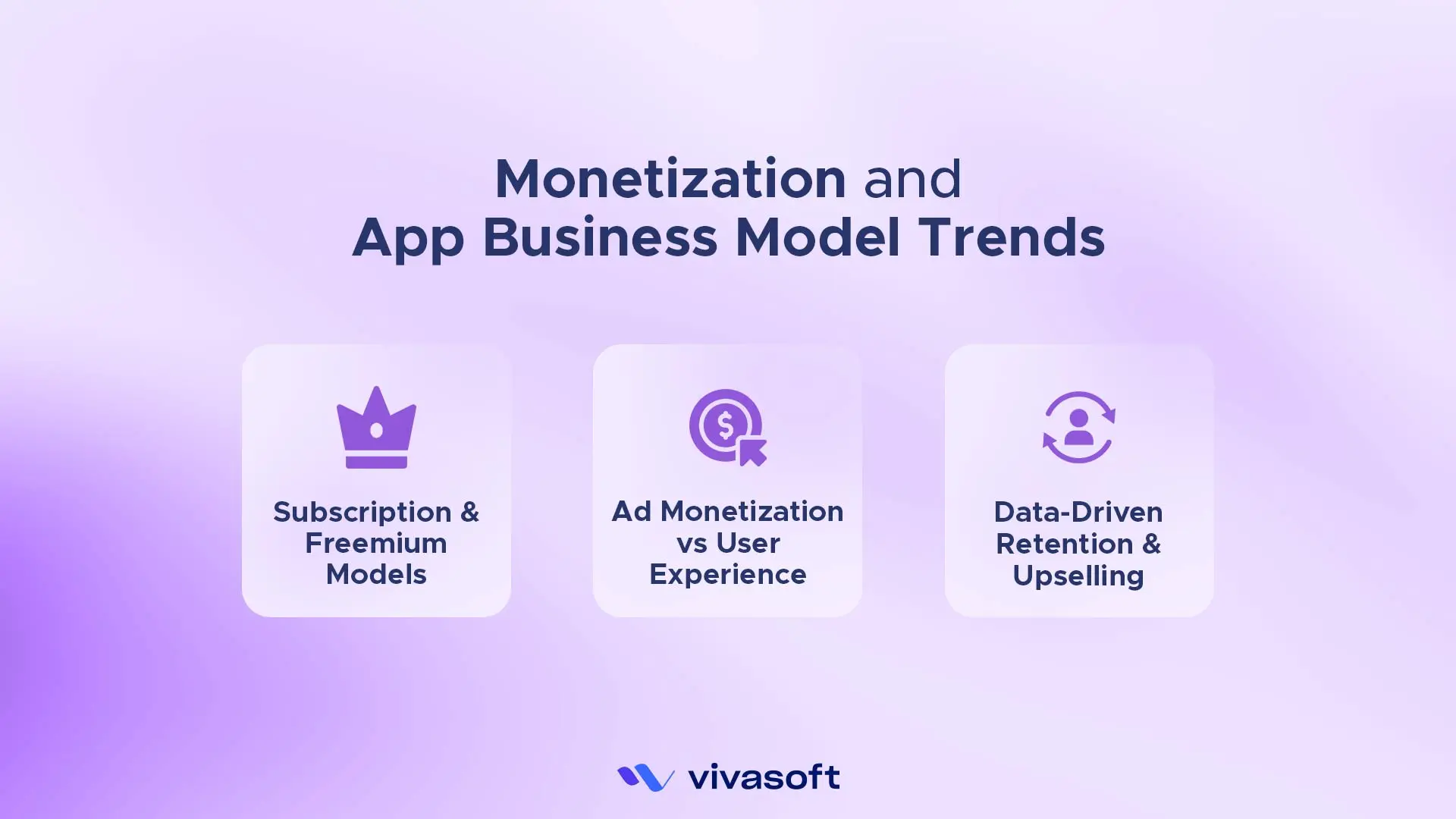
Now, let’s look at how the top app monetization and business models will drive growth in 2026.
Subscription & Freemium Models
Subscription models offer predictable income every period instead of one-time payments. Among them, freemium models are super popular, which let everyone access for free. Then encourage only serious or high-intent users to upgrade to paid tiers. Some of the smart triggers are used here, like adding limited smart features, reminders, or time-based locks.
These tactics increase the conversion rate extremely. For example, elite performers like Spotify have successfully converted closer to 40% of their freemium base. Use trial-start rate and trial-to-paid conversion to track and continually refine the onboarding.
Ad Monetization vs User Experience
Ad-based revenue can drive the audience quickly, but it is not free of a real retention tradeoff. Rewarded ads often offer the best balance as users choose to watch them in exchange for something.
Native ads come next. They appear naturally in the interface and keep the friction low. The safest way to find the right balance is to run structured A/B tests. For instance, set up two variants:
Variant A: Native ads should be placed after key user actions.
Variant B: You show rewarded ads only after users reach milestones.
Data-Driven Retention & Upselling
Retention analysis is trending now as businesses always want their existing customers to continue with the brand rather than get new ones. There is a common belief that reducing churn increases LTV far faster than acquiring new users.
Now, to get that effective analysis, use the cohort analysis and identify drop-off points. Ask users to upgrade only after they’ve experienced key benefits to make them feel things naturally.
To guide these decisions, track three essential KPIs:
- DAU/MAU ratio
- 7-day retention
- LTV/CAC
Popular App Categories & Consumer Trends in 2026
Have a quick glimpse at the most popular app categories with the latest trends for 2026:
Most Downloaded & Highest Revenue App Categories
Gaming apps continue to dominate global download charts. They can generate strong revenue mainly through subscriptions and in-app purchases. Research finds that gaming apps make the most money per download on iOS compared to other app categories.
In contrast, cloud-based business apps and streaming services also generate handsome revenue, but installation amounts are smaller. So, developers should consider both downloads and revenue potential when selecting categories.
Shifts in Consumer Behavior (attention, privacy, payment methods)
Users expect apps to deliver value immediately, often within the first few seconds. In case of slow or confusing apps, they leave. For instance, users are constantly rejecting intrusive tracking and expect clear, transparent data handling from apps.
Meanwhile, the rise of digital wallets is changing checkout flows in commerce apps. To keep pace, developers are tracking bounce rates, payment completion times, and privacy opt-in trends to make informed decisions.
Predictions for 2027+ (edge AI, spatial computing, hyper-personalization)
By 2027, edge AI will run heavier models directly on the device. It will reduce the round-trip delays and deliver near-instant outputs. Even spatial computing will expand beyond phones, foldables, and wearables.
Apps will become smarter with hyper-personalization and address every single interaction for the users. These changes will make apps faster and more interactive.
Data Privacy, Security & Compliance for Mobile App Development Trends
With enhancing user experience, it is just as important to make the user’s data secure and compliant. There are so many trending questions about Data Privacy and security of a mobile app. So, we have tried to answer them below.
How Do I Store Consent Logs Under GDPR and CCPA?
You can record each consent with a timestamp and a hashed user ID. Then secure these logs in a secure, tamper-proof system with clear information to stay compliant and audit-ready.
Which Logs Should I Keep for Audits?
It is better to keep important records for audits, like access logs, the logs of user consent for their data, data-deletion requests, and so on.
When Should I Use On-Device Processing?
Try to use on-device processing when your task needs personal information. This way, you will keep the raw data local and reduce privacy and security risks.
How Do I Secure Mobile Data at Rest?
Utilize the hardware-based security built into the device to secure mobile data. Encrypt sensitive information at the field level and keep authentication tokens or keys in secure storage.
How Do I Secure Data in Transit?
To secure data in transit, first make sure the server is trustworthy and has certificates. This helps prevent fake servers from intercepting data. Also, block outdated TLS versions and use modern, secure encryption protocols.
Regional Mobile App Development Trends (Asia / Europe / Americas)
You will find completely distinct scenario trends in different regions. Let’s have a look at them.
Asia
Asia’s mobile ecosystem grows faster than any other region. The APAC super-app market reached US$43.28B in 2024, which is expected to expand to about US$272B by 2032 at ~25.8% CAGR. People here are also heavy mobile-wallet users, about 1.4 billion, almost close to half the global base.
SNS Insider reports global mobile-payment volume at US$3.1T in 2023, which is expected to reach about US$14.5T by 2032. To achieve success, developers should focus on Android-first, lightweight apps and integrate local payment systems.
Europe
Europe’s mobile app market reached US$52.38B in 2023, which continued to expand as enterprises digitize operations. Users here are more concerned about privacy than users in other regions.
An ECB survey found 60% of euro-area consumers are worried about privacy when making digital payments. For that, they enforce GDPR rules strictly, with fines up to €20M or 4% of global revenue. To achieve success here, you must offer privacy-first paid tiers.
Americas (US / LatAm)
The Americas show distinct app trends across regions. In the US, app downloads suddenly slowed down to 12.3 billion in 2024, but in-app revenue grew to US$52.4B. Gaming apps are always strong here.
In Latin America, fintech and super-app adoption rates are always higher, with about 3,000 fintech startups, a 340% increase since 2017. People mostly like mobile commerce and wallet-led payment journeys, with platforms like Mercado Pago leading the way.
What to Watch in 2026-2027 and Beyond About Mobile App Development?
Beyond mobile app development, there are trendy areas you should know about for the upcoming 2026–2027.
- Edge AI commoditization: AI models will run directly on devices. They will become smaller and faster, handling real-time decisions for app features.
- Spatial computing platform wars: Big tech companies will also compete more aggressively to control 3D development tools and APIs.
- Privacy-first adtech: Brands will target ads directly on the device without exposing raw user data. They will personalize content only with user consent, respecting privacy choices.
Final Thoughts
In 2026, mobile app innovation will be driven by AI-powered personalization, 5G speed, cross-platform frameworks, data privacy, and evolving monetization models. To keep pace with the mobile app development trends, businesses and developers must balance AI automation with human creativity.
Only this will help to create immersive experiences. Looking ahead, 2026 will focus on edge AI, spatial computing, and hyper-personalized ecosystems. If you want to stay ahead in this innovation, start aligning your development strategies with AI and data-driven personalization today.
FAQs
What are the latest mobile app development trends in 2025?
AI-powered personalization, the continued demand for super apps, 5G speed utilization in app usage, and privacy-first approaches are the top trends, and brands are evolving accordingly.
Will AI replace app developers in the future?
AI can only automate repetitive tasks and help developers work much faster and make them more productive.
Is mobile app development still profitable in 2025?
No doubt, mobile app development will still be profitable in 2025. There is strong demand for apps with AI, 5G, and edge capabilities that increase revenue.
What are the most popular app categories right now?
The most trendy app categories right now are gaming, entertainment, and social media. Apps in fintech and health & fitness are also popular.
How can developers prepare for future app trends?
Developers can boost app engagement and discovery by proper utilization of the latest technologies. They should enhance skills in trending areas like edge AI, spatial computing, and cross-platform frameworks.